Showing posts with label HOBBIES. Show all posts

June 20, 2012

Favorite fun

Bareback on "Florida"

When I'm not writing, I love to do research (for my writing).

May 23, 2012

A dietitian's hobby

 
For dietitian Joy Ahrens, a favorite hobby is the art of paper folding. See her shimmering art work and read about her technique at her website, Joy of Folding.

LINK
Follow hospital dietitian Mary Ann Dames - a STEM career glimpse.

April 18, 2012

Creative fun - easy-to-make mini perfume bottles

Once upon a time, I needed a gift for a friend who moved a lot as a student, lived in small homes, and used to collect miniature perfume bottles when she was a kid. What could I dream up that would be small and fun for her?

Later that day, I was back from the bead shop with four beads, and done glueing them together and onto a piece of plastic cut from discarded packaging.


It was great fun for me too!

February 22, 2012

Earth Day every day

One of my favorite hobbies is imagining ways to reuse things, for the environment's sake.

Recently, my sewing basket of 20-some years failed. The wicker snapped in the back (not seen in photo) of the hinged lid. I couldn't fix it and make it look good. The parts poking out could have scratched anyone using the basket.


What if I removed the lid and saved the rest?

If it couldn't be a sewing basket any more, what else could it be?

Maybe a plant pot cover. But what plant pot would fit? Several small round ones? Would the plants look lost?

Later that day, I gathered the week's recyclables. Look what was among them:


A salad box. Yes, occasionally when life really gets too busy with family activities or good work, I'm guilty of buying salad boxes instead of lettuce.


All the box needs is a few holes at the bottom to let water drip out.

And plants.

February 21, 2011

Life tip: a weight control trick

It's hard for me to avoid gaining weight, but I manage to do it by being active enough and by not eating (too much) more than I should. In fact, "Stop eating when you're full" is one of the heatlthy-lifestyle tips I give in my science book, The Night Olympic Team. But it's easier said than done!
.
To be able to follow my own advice, I use a trick. Before sitting down for dinner, I plan an irresistible fun thing to do afterwards, so I can't... resist doing it--instead of having seconds. It's often a craft activity.
.
For example, I just finished making a birdhouse pin. First, I sketched it on scratch paper. Then I made it out of modeling clay (the brand name is Sculpey). This took several sittings. After making sure I liked the birdhouse, I hardened it by baking it in the oven (pencil shown for scale):
.
.
Next, I painted it with acrylic paint:
.
Finally, I glued the hardware (available from bead shops, craft supplies shops, or jewelry supplies shops) on the back.
Chirp!

January 12, 2011

Guess who this kid grew up to be in my book, The Night Olympic Team

Readers of my science book, The Night Olympic Team, ask me for glimpses of the childhood and career path of the key players in the book. Here's one.
.
They could not keep him from tinkering forever. When he was in third grade, he walked past their hobby shop on the way to school. What he wanted was not model airplanes, but the vials lined up on a shelf, full of colorful stuff: salts, minerals, chemicals. He knew they would make for great experiment. He asked the shop people "how to make something cool happen--catch on fire, maybe blow up?" But instead of helping him, they refused to sell vials to him. Imagine that!
.
.
Despite this setback, he grew up to be a scientist who would use recombinant DNA technology (a way to cut and paste DNA) to invent a supermedicine. While in college at the University of California at Irvine, he fell in love with DNA. He thought, "Cool! That's what I want to do. Work on that."
.
.
He started doing research for the professor who had inspired him. He earned a bachelor's degree in biological sciences, then a doctoral degree in molecular biology and biochemistry. For years afterwards, he studied how DNA programs a cell's life and death.
.
He went to work for a company which uses biotechnology (one kind of DNA science) to discover medicines to improve people's lives. He started to do research on a protein that's a natural hormone in the body. Soon the company began selling as a medicine an artificial version of the hormone.
.
Then there was no need to do research on it any more, right? Wrong! Our mystery man explains why his company continued to study the medicine: "Here we market this wonder drug--we simply must know all about it, understand everything about it."
.
Working on this medicine year after year, he could picture every bit of it in his sleep. Studies showed that the more sugars on the molecule, the better it worked. Logically, our mystery man set out to put as many sugars as he could fit on the molecule, and began creating new versions of the medicine.
.
.
Some said, "It won't work." Their thinking was that nature had improved this hormone for millenia. Nature had already made the hormone the best it could be. How could humans possibly make it better?
.
Our mystery man said, "How do you know unless you try?"
.
For a kid not allowed to tinker with colored powders, he was having some fun now. He made hundreds of new versions.
.
He worked on the project after hours, on the side, because it was not a "sanctioned" (official) project. His company already made the wonder medicine of all ages. What could top that? Why bother to try? Especially he, who was already a successful scientist by any measure imaginable--working at a world-famous company, published, respected. But he was determined. His enthusiasm got others interested in helping him. They also stayed after hours, testing each new version. Some didn't work, but some worked better, one of them especially.
.
He had succeeded at what some said was impossible. He had created a supermedicine that lasted longer in the body.
.
How had a human mproved upon something that nature had already improved over millenia? Nature refined the hormone to be made whenever the body needs it. The difference with its use as a medicine is that patients get shots. Fewer shots are possible because the benefits last longer--and that makes life easier for the patient. Not bad for a medicine that Steve was not supposed to work on officially.
.
From his lab freezer, he pulls out a white plastic tray packed with vials--his very own grownup collection. "Mutants," he says, his voice resonating with pride. In the palm of one hand, he holds the fruits of years of labor.
.
.
By trailblazing where nature had no plans to go, he made something cool happen for millions of patients.
.
WHICH ONE OF THE KEY PLAYERS IN THE NIGHT OLYMPIC TEAM IS HE?
.
In order of appearance:
.
Jeff Gorzek, scientist, who tests athletes' samples for prohibited drugs?
.
Don Catlin, scientist and lab director, whose team found a prohibited drug in athletes' samples? The drug was a blood-booster medicine invented to treat medical patients, not to help healthy athletes cheat by boosting their endurance!
.
Steve Elliott, scientist, who invented the medicine?
.
Jacques Rogge, President of the International Olympic Committee?
.
Jan Paulsson, lawyer?
.
Zac Douglas, lawyer?
.
IF YOU GUESSED STEVE ELLIOTT, YOU WERE RIGHT!
.
Steve is a Scientific Director at Amgen, a therapeutics company in Thousand Oaks, California. He worked on EPO, the body's natural blood-boosting hormone. He led the team that invented NESP (also called Aranesp or darbepoetin alfa), a longer-lasting version of EPO. He plays a key role in The Night Olympic Team.
.
MORE ABOUT STEVE
.
Steve loves to play golf... before going to work.

December 17, 2010

Follow a science writer and editor crafting a book subtitle – a STEM career glimpse

by me, your blogger, Caroline Hatton
.
.
If you love words and science, you can live happily ever after as a science writer.
.
Science can transport me into whole new worlds. So can reading. But when I write, I have the power to take readers into another world.
.

Capturing science book ideas
.
Most science writers are scientists who love writing (like me) or writers who love science.
.
Science writers must be capable of learning about at least one area of science, and they must write well enough to make it clear and infect readers with passion.
.
I have two science degrees: a pharmacist degree and a Ph.D. (Doctor of Philosophy, a doctoral degree) in Chemistry. As a scientist, I help test athletes for performance-enhancing drugs that are prohibited in sports because using them is cheating, it can be dangerous to health, and it's contrary to the spirit of sport.
.
While working at the 2002 Winter Olympics in Salt Lake City, I was on the team of scientists that caught three athletes on a prohibited drug. They had won a total of eight medals. We scientists helped officials and lawyers determine that the right thing was for the athletes to return all their medals, so they could be awarded to the rightful winners.
.
I'll never forget the night, the instant when the thought flashed through my mind, "Some day, I will write this story for children."
.
So I did!
.
My article, "The Night Olympic Team," got published in Cricket in the United States, then in The School Magazine in Australia and YES Mag, a children's science magazine in Canada (under the title, "Finding Gold for Canada").
.
I spent two years growing the article into a book. When I submitted my book manuscript to editors, the title was The Night Olympic Team and the subtitle was Inside a Drug Scandal.
.
For nonfiction books, I like when the title is intriguing and the subtitle crystal clear. That way, the title grabs me and makes me itch with curiosity. But the subtitle had better tell me exactly what the book is about.
.
The Night Olympic Team is a title that I had tried to use since the Fall of 2000. My longtime boss, beloved friend and a pioneer of drug testing in sports, Dr. Don Catlin at the UCLA Olympic Lab where I worked, had just come home from the Summer Olympics in Sydney. He had been asked to write a report for a campus newspaper, UCLA Today.
.
As his ghost writer, I often created drafts for him--internal university memos, manuscripts for scientists, lawyers or lay readers, international correspondence, and proposed protocols and policies for drug testing in sports. My words jumpstarted his thinking. Can you imagine how much more you could get done if someone drafted your homework for you?
.
Sometimes Don Catlin signed the letters I printed for him. Other times he threw out all my words and ideas, and wrote his own piece. Between these extremes, we spent many hours and days of our lives revising, debating, bickering, arguing, or avoiding one another, all for the sake of helping one another and fighting for The Cause--against drugs in sports--to protect the athletes' freedom to compete without taking drugs.
.
For UCLA Today, the report I drafted for Don in 2000 began like this:
.
The night Olympic team
.
The [N]th Olympic Summer Games are over down under. Beneath the exuberance, fanfare and cheer there were discordant notes every time athletes got caught with performance-enhancing drugs in their urine--but we heard so much about positive tests only because the multinational Olympic team at the Sydney laboratory did such a good job finding drugs. The scientists deserve medals, yet the only gold they got came in specimen bottles in the middle of the night.
.
When Don read that last sentence, he humphed, "Gross. No one's going to print anything like it." Although he never submitted my draft for publication, eight years later (in 2008), my book was published with something very much like it on the first page. :-)
.
As for the subtitle, Inside a Drug Scandal, one Friday afternoon in 2007, three months before my book manuscript was to be declared final and sent to the printer, my editor extraordinaire (that's a French word that means that he's a star), Andy Boyles at Boyds Mills Press, e-mailed me about it.
.
His concern was the suggestion that the book might be about "the *latest* drug scandal, whatever that might be years down the road." Prospective buyers night think, "Oh, I just read about that in the Times. No need to buy this book."
.
Andy wanted the subtitle to indicate that the book is not only about one scandal, but also about the general effort to quash the use of drugs in sports. He had spent time trying to come up with ideas and shared a long list of possibilities, including:
.
THE NIGHT OLYMPIC TEAM
.
The lab that fights drugs in sports
.
Keeping drugs out of the Games
.
Fighting drugs in sports
.
.
The following Monday afternoon, I replied by e-mail:
.
How about
.
THE NIGHT OLYMPIC TEAM
.
fighting to free sports from drugs
.
or
.
the untold story of a drug scandal
.
.
Andy sent three new ideas, one of which, "Fighting for Drug-Free Games," he acknowledged to be a bit of a tongue-twister. His e-mail ended with "???"
.
To avoid missing any possibility, I wrote keywords on paper slips and shuffled them, reading the permutations aloud until I got this:
.
.
Then I went to peck on my keyboard:
.
THE NIGHT OLYMPIC TEAM
.
Fighting to Keep Drugs Out of the Games
.
?
.
I liked the ring of it all. It rolled off my tongue easily with no risk of tripping and with a nice, strong beat.
.
I clicked "Send."
.
The phone rang. It was Andy. He wanted to make sure I could live with it.
.
Yes!
.
My book had a title and a subtitle. It was becoming real.
.
This was a milestone in the life of my book, itself a milestone in my life. And it was only the eight-word subtitle of a 6,000-word book! The rest... is another story.
.
.
ABOUT ME, CAROLINE HATTON
.
When I'm not working, I love to make miniatures, quilt, hike, backpack, ride horses, or cross-country ski.
.

.
LINKS AND MORE

* Follow a science writer...

...shaping a book.

...using a motivation trick (telling a friend).

...using a motivation trick (keeping a Hope Journal).

...using a motivation trick (finishing projects before starting new ones)

* Read a paragraph-long description of science writing careers at the Sloan Career Cornerstone Center.

* For an overview, read "Science Careers: Science Writer" at ScienceBuddies.org.
.
* For another overview, read "A Guide to Careers in Science Writing" by the Council for the Advancement of Science Writing.
.
* For a brief overview and paragraph-long profiles of the contributors to the Computing Life website, read "Writing Life" by Emily Carson.
.
* For a thrill, read an article and brief summaries about the winners of the science journalism awards of the American Association for the Advancement of Science.
.
* Read fascinating notes about how award-winning author Caroline Arnold got ideas for her books, such as Global Warming and the Dinosaurs, and about her experiences researching and writing them. She is the author of 150 children's books inspired by her love of nature and by her travels. Many of her books have received awards as science books.
.
* Find out how author Sneed B. Collard III researches some of his science books for older younsters.
.
* Read about how I do research for science writing, in this interview of mine by another author, Vicki Leon:
.
- part 1 about interviewing experts... with more or less success!
.
- part 2 about fact-checking
.
- part 3 about weaving together the scientist's adventures in life and the science
.
* Read a terrific interview of astronomer, teacher, and science writer Alan Hirshfeld (part 1 and part 2) by Vicki Leon.
.
* Get some tips for adult, professional beginners.
.
* For clear, strong advice to help you become a better science writer, read Chapter 15, "Science and Technology," in the book by William Zinsser, On Writing Well - The Classic Guide to Writing Nonfiction. It's one of my favorite chapters in one of my favorite books about writing.
* Read about a job broader than just writing, in the article "Science Communication as a Press Officer" by Christine Pulliam, who has a Master's degree in astronomy.

* For an overview of a related career, Technical Writer, read the ScienceBuddies.org page.
.
Updated March 29, 2012.

December 10, 2010

Winter fun – a puzzle

By mid-December, my husband Bill and I plan a cross-country skiing vacation around New Year's Day. We live in California, so we often ski in the Sierra Nevada.
.
Here we are east of Yosemite National Park:
. .

.
We look for animal tracks such as these:


The wooden stick is one inch long.

Can you guess whose tracks they are?

Click here for a clue and for the answer.

November 30, 2010

Holiday fun – a test of observation skills

The day after Thanksgiving, my thoughts turn to an ongoing Christmas project.
*
It all began several years ago, when I saw small Christmas stockings in a store. I liked how they were decorated in detail, but not the color (pale blue) or the price (several dollars each). Besides, most of the time, seeing something I like makes me itch to craft it myself.
*
So I couldn't wait to get home to design and make my own, smaller stockings:
*
*
They are 1-1/4 inch wide. The bright blue and black ones, in my husband's favorite color pair, are for us. The gray and dusty blue ones are for my big brother's family, in colors I've seen them wear.
*
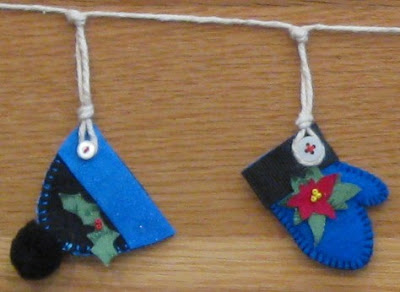
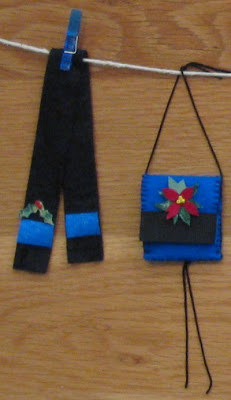
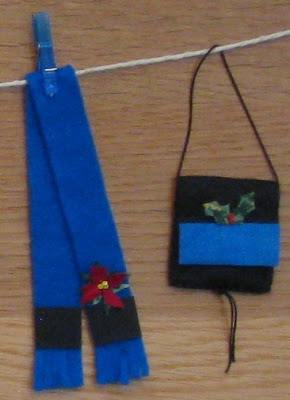
The following year, I made six mittens. The year after that, hats. Then scarves, and now shoulder bags:
*
*
Here's the puzzle to test your observations skills: the black and bright blue ornaments follow a pattern, but there are four departures (deviations, details that don't follow the pattern). Can you spot them?
*
** *
Click here for clues and the answer.

October 31, 2010

Follow a geochemist to Antarctica – a STEM career glimpse

by Jennifer Middleton, B.A. (Bachelor of Arts, Earth and Planetary Science)

If you like outdoor adventures, you might love to be a geochemist.

Geochemists are both geologists and chemists. As geologists, they study the world around them by observing rocks. As chemists, they examine the compounds and elements that things are made of. Geochemists use the compositions of rocks (or fluids, or gases) to understand how Earth systems (such as volcanism or the climate) work now or how they worked in the past.

As a geochemist, I study the history of Antarctic glaciers by analyzing rock samples from the Dry Valleys of Antarctica.


The Dry Valleys region is a cold desert, so dry that it doesn’t get enough snow to be covered with ice. Have the Dry Valleys always been ice-free, or were they ever covered by ice sheets? Scientists need to understand how the Antarctic ice sheets behaved in the past in order to accurately predict how they will react to global warming. Geochemists are detectives who can decode the clues hidden within the region’s rocks, by measuring isotopes.

Isotopes, such as neon-20 and neon-21, are variations of the same chemical element with different masses. When a rock is exposed, high energy particles from outer space (cosmic radiation) produce special isotopes (cosmogenic nuclides) in the rock. Some (such as neon-21) are stable and always stay in the rock grain in which they are produced. Others (such as beryllium-10) are unstable and radioactively decay over time. A rock covered by thick ice is shielded from cosmic radiation and no new cosmogenic nuclides are produced. Beneath the ice, the number of stable nuclides stays the same, but the number of unstable nuclides goes down as they decay. The proportions of cosmogenic nuclides in a rock reveal whether it was ever covered by a glacier. With enough rock samples, we can find out what an ice sheet looked like millions of years ago.

First, our team needed to go to Antarctica to collect samples (the best part of studying the Earth is that you get to see the world). Because Antarctica is in the southern hemisphere, we did our field work between November and January during the Antarctic summer (otherwise it would be too cold). Just getting to our field site (where we wanted to collect samples) required a long flight in a military plane from New Zealand to McMurdo Station (the major U.S. research station in Antarctica), a short helicopter ride to our campsite in the Dry Valleys, and a short hike to the field site.

Every morning, we woke up in a beautiful landscape all to ourselves. We carried backpacks containing sample collecting gear, extra warm clothes, a thermos of hot water (even in a cold desert we needed to stay hydrated) and plenty of snacks. No flashlights though—the sun never sets during the Antarctic summer!
.

At the field site, we sampled the bedrock, not loose rocks such as boulders, which might have been moved from elsewhere. We made sure that the rock could “see” the sky so it had enough cosmogenic nuclides to tell us something about the past. We avoided rocks that were shielded by other rocks. We also wanted rocks made of large grains, because when we analyze them in the lab, we pick the grains one by one with tweezers, so the bigger the better. Finally, we looked for a vulnerable spot (near an edge or a crack) so that it wouldn’t be too hard to break off a chunk.
.
This chunk had to be about the size of a grapefruit. Collecting it usually took a few good whacks with a hammer and a well-placed chisel, but sometimes it took me several minutes of rock abuse before the sample was free. Next, I took the GPS coordinates of the sample location and wrote them, along with the sample name (not Bob, but for example, SR-08-007 for the seventh sample taken in Sessrumnir Valley during the 2008 field season), in my field notebook and on a canvas sample bag. I also wrote down the type of rock, the name of the day’s field site, and the amount of shielding from nearby mountains, cliffs or ridges. I needed to keep track of all of this information to interpret the data we would get from analyzing the sample.
.
I took photos of the sample and surroundings to remember all of the details months or years later. Finally, I stuffed the sample into the bag and moved on to collect another sample. At the end of the day, I put all of my samples in my pack to carry all 20-30 pounds back to camp. There, we packed our bagged samples together in wooden boxes to be flown back to McMurdo Station, then shipped to the U.S.
.
We needed a lot of samples from many different places to develop a good understanding of what the region was like in the past. We spent a month camping around the Dry Valleys and collecting samples.
.
We returned to our lab at Harvard University in January 2009. But our samples didn’t leave Antarctica until February, when the sea ice around McMurdo Station got thin enough for a ship to come pick them up. They didn’t arrive at our lab until April 2009. Even then, we had to prepare each sample before the analysis could begin.
.
LAB WORK DETAILS: To prepare each sample, I crushed a piece and separated the grains. Under a microscope, I used tweezers to pick out the grains I wanted: only grains of pure quartz from our sandstone samples, because the cosmogenic nuclides we wanted to measure are produced only in quartz. This step took a few hours for each sample. In time I started to enjoy the simple beauty of clear quartz grains at high magnification.
.
Next, I soaked the quartz grains in a strong acid solution to remove contaminants from the outside of each grain (this was the only time in my science career when I actually wore a lab coat). Contaminants mess up measurements, giving us the wrong information about what really happened in the Dry Valleys. After the acid soak, I rinsed the grains with purified water (the acid is a contaminant too!), dried them, weighed them, and wrapped them in niobium foil (like aluminum foil, but stronger and more expensive) before loading them into the machine that measures isotopes (the mass spectrometer).
.

With the measurements, the mass of the rock grains we put into the machine, and the information we gathered about each sample in the field, we can calculate how much of the cosmogenic nuclides were in each sample and deduce the exposure history of our field site.
.
Our results and conclusions will help support or rule out different hypotheses about the past and future of the climate of Antarctica, and help settle current debates among scientists world-wide. So, were the Dry Valleys covered by an ice sheet millions of years ago? If they were covered, when did this happen and for how long? Well, we’re still working on it, but I’ll let you know when I find out.
.
ABOUT JENNIFER MIDDLETON
.
When Jenny is not working, she loves reading, watching scientifically inaccurate natural disaster movies, and playing outside.
.
LINKS
.
* Relive Jenny's expedition in Antarctica at her team's blog.

* Read an article about Jenny's mission in Antarctica.

* Read a description of geochemist careers.

* For an overview of geoscientist careers, click on “Listen to the podcast…” at the Sloan Career Cornerstone Center. It’s an introduction to the required schooling, a day-in-the-life of a geoscientist, and jobs.

* For another overview, read "Geoscientist" at ScienceBuddies.org.

* Link to 23 geoscientist profiles including an astrogeologist, a geophysicist, a hydrologist, a micropaleontologist, and an energy policy program manager.

* Watch the video, Careers for Geoscientists, about opportunities to work on the atmosphere, oceans, and the solid-Earth. Interviews reveal adventures and travels, outdoor work, and use of high tech instruments.

* Watch a video of geochemist Andrew Jacobson sharing how his path into geology took him to the Himalayas. The video is long (28 minutes) and a bit slow, but worth the time if you want to get a feel for life as a geology professional or as a college student.

* Watch a video of geochemist Frank Ramos. Beginning at 14 minutes, you can visit his lab and watch student researchers extract the interesting parts of rocks for analysis. Beginning at 20 minutes and especially from 23:30 to 29 minutes, see a simple explanation of how a mass spectrometer works (the same kind of machine that Jenny Middleton uses).
.
* Read about the fascinating moment when an arts major turned into a geologist.

* Read about world-class expert seismologist Lucy Jones, "the Earthquake Lady" her work and career path, beginning at age eight.
.
Updated on January 28, 2012

September 14, 2010

Follow a dentist – a STEM career glimpse


by Minh Tam Dang, DDS (Doctor of Dental Surgery)
.
.
.
If you like taking care of people, as I do, you might love to be a dentist like me.
.
I do a large variety of things at work, including saving teeth and smiles. Like the day a commotion in the waiting room drew me out of my office. Anguished voices talked at the same time.

“Oh, my!”

“He got banged in the mouth."

A teen was pressing a blood-stained tissue on his lips. His father leaned over the receptionist’s counter.

“He broke a tooth right in front.”

I took the wounded boy to the big chair. “Let me look.”

The dental assistant gently rinsed the blood away with a stream of water so I could see. “Only one tooth looks damaged.” It was a top tooth, one of the two middle ones, broken at a slant one third of the way up. “Let’s take an X-ray.”

The dental assistant led the boy to the X-ray cubicle while I walked to my desk to wait for the digital image to appear on my computer screen. I stared at the tooth all over—what was left of it—especially the root, the bone around it, and the middle of the tooth, or pulp chamber, containing the nerve. The break was far enough from the pulp chamber, so there was no need to empty it, then fill it with an artificial material (do a root canal treatment).

Dr. Dang reviewing an X-ray (but not the one in the story)


That was very good news. A live tooth is stronger and sturdier than a dead or fake tooth.

The plan, then, was to cap the broken tooth with a temporary crown and replace it with a permanent crown later.

A crown is hollow, somewhat like a pencil cup. Its outside shape must match the original tooth. Its inside shape must fit the broken tooth—after it’s been prepared by filing it down, to make room for the crown.

First I numbed the tooth and gum with pain killers (anesthetics), by rubbing a numbing gel on the gum, then giving an injection next to the tooth. After a few minutes, I made sure the patient couldn’t feel a thing by testing the gums all around the tooth.

Next, I pictured the prepared tooth in my mind and filed down as needed. The taper and smoothness were very important for the finished product to look good, with no visible line where the crown would meet the natural tooth, just under the gum line. It was like carving a miniature sculpture, except it would not sit in a glass case untouched--it would chomp on food, many times a day for years to come. It would also be seen every time this young man smiled.

I took a mold (impression) of the prepared tooth. I filled a special, small “tray” with a special, soft paste. I squirted softer paste on the tooth to capture the finest details of the edges, so the crown would fit perfectly.

I put the tray in place and asked the patient to bite down. Minutes later, the paste had hardened (set). I took the tray out, sprayed it with disinfectant, and bagged it.

To order the crown, I wrote up the lab slip and asked the lab to make it of porcelain (not porcelain fused to metal or gold). I specified the color closest to that of the other teeth. I held a color chart next to the patient’s teeth and he helped pick the shade.

The lab courier, who comes by every day, picked up the bag and slip. It would take the lab roughly two weeks to make the crown.

Meanwhile, the patient needed a temporary crown. The dental assistant made it, because no pre-made, stock acrylic crown was quite right. She glued it on with temporary cement.

The patient walked out smiling and having silly fun with the numbness, which would disappear within a few hours.

Every team member had to do excellent work to get fine details just right.

As the dentist, I had to prepare the tooth so it would be just the right size and shape. It couldn’t be too thin or it would break. It couldn’t be too thick or else it’s the crown that would be too thin. The filing-down couldn’t come too close to the nerve or the tooth would be sensitive and hurt all the time. The mold could not be distorted, or the crown wouldn’t be the right shape inside and it wouldn’t fit.

The dental assistant faced many similar challenges when putting together a temporary crown.

The lab people used the mold to make a plaster model of the prepared tooth and neighboring teeth, then made a permanent crown on the model. When this crown was ready, it was tried on and final adjustments were made for a perfect fit, before it was cemented in place.

Crowns can last a long time (if their owners take care of their mouths, by brushing twice a day, flossing once a day and seeing a dentist every six months) and that’s something to smile about!

ABOUT MINH TAM DANG

When Tam is not working, she loves arranging flowers, gardening, playing with her two cats (Diddi, also known as “The D,” and Louie), painting with watercolors, quilting, reading and writing Vietnamese poetry, and playing tennis, hiking or riding bikes with family.

LINKS

● Watch this short video overview of dentist careers.

● For a little longer overview of dentist careers, click on “Listen to the podcast…” at the Sloan Career Cornerstone Center. It’s an introduction to the required schooling, a day-in-the-life of a dentist, salary info, specialties, and the great job market in the years ahead.

● For dentist interviews, click on the names below.

Jennifer Cyriaque

James Tynecki

Stephen Sterlitz

● Watch this 25-minute award-winning career video about “Women in Dental Research.” After a brief history of dentistry, it follows three amazing women. One fought the AIDS epidemic, the second one, a molecular researcher, studies oral disease and cancer, and the third one leads researchers who provide free dental care to children.

July 19, 2010

Behind the scenes at the Olympics - A pharmacist’s story


In the previous post, Peter Ambrose showed you exactly how a hospital pharmacist takes care of a patient. Would you like to know how he, as a pharmacist, got a front row seat at the Olympics… for free? Read about his adventures at the 2008 Summer Olympics in Beijing and see his photos at his blog, “My Olympic Journey.”


ABOUT PETER AMBROSE

When Peter is not helping others as a pharmacist, he loves camping, hiking, fishing, planting flowers and vegetables, and working out with weights. He also enjoys watching many sports, especially from the front row at the Olympics!