Showing posts with label girls. Show all posts
June 27, 2012
Get inspired by women inventors
Hear a 30-second review of the book, Women Invent! Two Centuries of Discoveries That Have Shaped Our World, by Susan Casey.
Labels:
BOOST-STEM,
girls,
high school,
middle school,
Tech Trek
June 21, 2012
Cool science summer camps
See "The 20 coolest STEM summer camps," a list that goes far beyond Space Camp, from the National Flight Academy in Florida to the Summer Safari Day Camp in D.C.
Labels:
career planning,
girls,
high school,
middle school
May 2, 2012
A conversation with a baboon scientist
Labels:
girls,
high school,
middle school,
Tech Trek
April 25, 2012
Great resource on STEM careers
Need info about a career as an athletic trainer, actuary, aquarist, and over 100 less mysterious professions? Go to the Science Buddies website. Look for the careers that are "In Demand!" Enjoy the videos, interviews, and profiles.
Labels:
career planning,
girls,
high school,
middle school,
STEM,
Tech Trek
April 17, 2012
High-paying jobs in demand
But which STEM jobs are growing fast? Read about the top five.
Labels:
career planning,
girls,
high school,
middle school,
STEM,
Tech Trek
April 12, 2012
Secrets from the sea
Marine biologist Tierney Thys works with other scientists to make films
that share the wonders they see. Watch The Secret Life of Plankton, a story
told... by a fish!
FURTHER RESOURCES
Go to the previous post for more about marine biologist Tierney Thys and her research.
Labels:
girls,
high school,
marine biologist,
middle school
April 10, 2012
Swimming with the world's biggest fish
![]() |
| Photo by Tonny Watanebe |
Watch marine biologist Tierney Thys tell stories about her studies of the giant ocean sunfish. This is the world's heaviest bony fish. It can reach 5,000 pounds!
LINKS
* Marine biologist Tierney Thys. As a kid, she loved being in the water. She learned to dive at age 15. Read her bio.
* Weird! All about sunfish: http://www.oceansunfish.org/
Labels:
girls,
high school,
marine biologist,
middle school,
Tech Trek
April 4, 2012
High school scientists publish!
Read the published articles at the website and see the submission guidelines.
High school scientists who conducted original research, performed the
experiments themselves, and wrote up the results, can submit manuscripts for
publication in this journal. A school teacher must co-author the article. The
research can be conducted at school or during an internship at a university
research lab (in which case the mentor also co-authors the article). The
authors experience the review and revision process that is standard in
scientific publishing.
Labels:
girls,
high school,
kid scientists,
science,
Tech Trek
March 29, 2012
Follow a science writer using a motivation trick -- a STEM career glimpse
Do you ever feel a burning desire to start a new project?
I often do, and I use it to fuel the completion of current projects, one by
one.
My experience is that new ideas are exciting--fresh, clever, perfect! I can't wait to get started on them.
But soon after starting, challenges arise--problems to solve. Maybe what I
have is not as good as what I had dreamed up. It's taking forever. It's just
plain hard. Then it sits.
Fortunately, I always have other ideas, and a burning desire to start on
those.
Here's my trick: I tell myself that I can't start a new project until I've
finished the current one. As if by magic, I begin to tackle problems, come up
with solutions, and find extra energy to get it all done.
How do I make myself finish the old project before starting the new one? I
have the discipline simply because this trick works like a charm.
The triumph of completing project after project and getting tons of things
done makes me want to use this trick again and again.
Try it a few times. If it helps, you too might want to do it again!
LINKS
• This motivation trick is more powerful for small, short projects than the last two: telling a friend or keeping a hope journal.
• For a ton of links about science writing, scroll down to
LINKS AND MORE after you click here.
Labels:
BOOST-STEM,
Caroline Hatton,
girls,
GLIMPSE,
high school,
life tip,
middle school,
science writer,
Vietnamese
March 21, 2012
Follow a science writer using a motivation trick - a STEM career glimpse
If you wish you could make more progress on a long, hard project, try this
trick. It helps me. Maybe it will help you too.
It's O.K. if you don't move mountains every day. Do your best to do
something, every single day.
I use this trick when I'm writing a book, and it's hard to find or make the
time after working as a scientist and translator, and taking care of family,
friends, and home.
I keep a "hope journal." It's not a regular journal or diary. I write in it
only what I've done to make progress on one project--nothing else--every day,
for two weeks or two months or until the project is done. One hope journal is for only one project.
A hope journal begins as a blank notebook. I like small books for my small
hands.
![]() |
| Hope journals for The Night Olympic Tea, Horse Stories, and two future books |
First, write the name of your project on the cover.
Then, every day, write down the date and what you did on that date to make
progress.
![]() |
| I like to circle the date, and to write in blue or black every other day. |
Writing in my hope journal at night was too hard because I was tired. Now I
write, first thing in the morning, what I did the day before.
For example, I wrote in my hope journal for Horse Stories, about a story entitled "Paco of the Andes:"
- I revised Paco in my hotel room, in pencil on a printout.
- I revised Paco in the plane on the way home.
- I started entering my edits into my Word file, from the printout I carried on my trip.
- I finished entering edits and reprinted Paco.
I submitted "Paco of the Andes" to The School Magazine in Australia in August
2008. The editor accepted it for publication within two months. It was published
within a year after that.
My horse stories are fictional, but I do research, check facts, and consult
experts, exactly as I would for science writing.
The funniest entry I made was in my hope journal for The Night Olympic
Team: I wanted to highlight background information, to make sure it didn't go on
too long, taking readers out of the ongoing story. But I dropped the
highlighter. It left a spot on the carpet. ARGH! I tried to get it off with spot
remover. When that didn't work well enough... I gave the carpet a haircut!
Keeping a hope journal is as powerful for me as telling a friend what I
will get done before we meet (read my post about that trick). The journal works
better because it goes on day after day.
LINK
• For a ton of links about science writing, scroll down to LINKS AND MORE after you click here.
Labels:
BOOST-STEM,
Caroline Hatton,
girls,
GLIMPSE,
high school,
life tip,
middle school,
science writer,
Vietnamese
March 7, 2012
Follow a science writer using a motivation trick - a STEM career glimpse
I use this trick when I'm working on a new writing, but have no deadline to
drive me to make progress.
Sometimes choosing my own deadline helps: "I'll complete the first draft by
March 31."
What helps ten times more is simply telling a friend. And what helps even
more is telling a friend whom I'm scheduled to meet, what I'll get done by the
time we meet: "I'll finish revising once by the time I see you."
For my writing, this works best with friends who are also writers. For my
science work, it works best with friends who are also scientists. They
understand what it takes to get the exact kind of hard work done. Their cheers
are most gut-felt.
Best of all, they can also tell me what they'll get done by the time we
meet. We can help each other even if the work is not team work.
Try this for a project dear to your heart, especially if it has no deadline
and you wish you could make more progress.
LINK
• For a ton of links about science writing, scroll down to LINKS AND MORE after you click here.
LINK
• For a ton of links about science writing, scroll down to LINKS AND MORE after you click here.
Labels:
BOOST-STEM,
Caroline Hatton,
girls,
GLIMPSE,
high school,
life tip,
middle school,
science writer,
Vietnamese
February 15, 2012
Treating blindness with robotics
Watch neuroscientist Sheila Nirenberg talk about how she wants to treat some types of blindness, by hooking into the optic nerve and sending signals from a camera directly to the brain.
For more on how to do this without surgery--with only an injection and special glasses!--watch the Q&A beginning at 3 minutes.
Read the article that explains that Nirenberg's team used gene therapy to add a special protein to specific cells in the eyes of blind mice, to make them responsive to light. Next, a pair of glasses containing a tiny video camera and computer used a math recipe (algorithm) to turn images into mini light flashes, which the glasses were equipped to shine into the eye. Then the blind mice could see!
Labels:
girls,
high school,
middle school,
researcher,
robotics,
science,
STEM,
Tech Trek
January 19, 2012
More on pharmacy as a career
Watch videos about pharmacy as a career at the website, Pharmacy is Right for Me.
For more, go to my initial pharmacy blog post, "Follow a hospital pharmacist," and don't forget to scroll down to the links at the bottom.
November 9, 2011
Vive Madame Curie !
Read a Smithsonian Magazine article on Marie Curie's passion for science, despite the barriers she faced because she was a woman.
A new play, Radiance: The Passion of Marie Curie, written by the actor and director Alan Alda, debuts November 9, 2011. Read his interview.
Labels:
girls,
high school,
Marie Curie,
middle school,
science,
STEM
July 12, 2011
Follow an analytical chemist who protects horses – a STEM career glimpse and puzzle
Horses thunder past, stretch across the finish line. The fastest one wins by a nose. Victory brings fame and fortune to the owner.
And this victory is the end result of generations of expert horsemen and horsewomen breeding generations of extraordinary horses, and of the horse’s years of hard work with fine trainers, so that the best may win on race day. At least that’s the way it should be.
Unfortunately, money is at stake, so that some people cheat to help a horse they own, or train, win races. One kind of cheating is doping by giving drugs to horses to make them run faster.
Some people give shots of blood booster drugs to horses. More red blood cells carry more oxygen to all tissues in the horse’s body, including muscles. Instead of getting tired in the last stretch, the horse can keep going full tilt. But this is cheating, therefore it is is prohibited.
How can one catch cheaters? By testing the horse for prohibited drugs: blood and urine samples are collected after races.
Lab scientists test the samples for prohibited drugs. If the scientists find one, the people responsible for that horse have broken the rules and must be punished.
But what happens when a new drug becomes available? For example, by 2008, a new and improved blood booster medicine, CERA, had become available. CERA was invented to treat humans who have serious medical problems, not to help healthy athletes or horses cheat!
Researchers in Europe invented a test to look for CERA in athletes’ samples. Sadly, they found CERA in athletes' samples, including from 2008 Tour de France and Beijing Olympics cyclists.
Fortunately for horses everywhere, Dr. Yan Chang was already working hard to fine tune a test to find CERA in horses’ samples. If there is a test, cheaters might get caught, so they will think twice before giving a horse a shot, and hopefully they will forget it.
Dr. Yan Chang
She spends three days just preparing the samples. She treats them in a special way that cuts the CERA molecules, if they’re there, into pieces. One of those pieces, “T6,” can only come from CERA, nothing else. So finding T6 proves that CERA was there. To see whether T6 was there, Yan analyzes her samples by chromatography and mass spectrometry.
Yan uses chromatography and mass spectrometry
to test horse samples for a prohibited drug
Chromatography separates the ingredients of a mixture. The mixture goes into the machine, and the ingredients come out one by one at the other end. In the example below, chromatography has separated the two ingredients in a mixture:
Yan uses chromatography to separate T6 from all the other things in the horse’s blood. Then she uses mass spectrometry to identify T6.
For an explanation of how chromatography and mass spectrometry help identify chemicals, watch my TV science lesson (part 1 – from 3:30 minutes to the end at 10 minutes) by clicking here.
How exactly does Yan read what she gets from a test—the data?
Yan reads data
First of all, she always compares the unknown sample to known samples (controls): one control known to be negative (-) (because it’s blood from a research horse who was never given CERA) and one control known to be positive (+) (because Yan herself sprinkled CERA into horse blood in a test tube).
(In my TV science lesson, I omitted the negative control for the sake of simplification, to make room for other details.)
Yan’s data look like this:
- In the picture below, for the positive control (+), Yan knows that T6 is present, and sure enough, there are two peaks. The two peaks line up on the same vertical. The top peak is bigger than the bottom peak. The top peak is three times bigger than the bottom peak. That’s what the data look like when T6 is present.
- In the next picture, for the negative control (-), Yan knows that T6 is absent, and sure enough, there is no peak.
- Yan now looks at the unknown data (?) in the picture below, and asks three questions.
- Question 1: are there peaks?
- If not, the sample is negative
- If yes, Yan goes on.
- Question 2: are the top and bottom peaks lined up with each other on the same vertical as the positive control?
- If not, the sample is negative
- If yes, Yan goes on.
- Question 3: is the top peak three times bigger than the bottom peak, like for the positive control?
- If not, the sample is negative
- If yes, the sample is positive for T6.
That’s the big idea, although it was simplified to avoid giving you a headache.
Now it’s your turn to be a horse-race detective. Ask Questions 1, 2, and 3 about samples A-I below. Decide which horse was doped with CERA.
A: Attahorse
B: Beeg
C: Catch Me Tomorrow
D: Desert Wind
E: Egg Beater
F: Flies Like An Arrow
G: Girl Power
H: His Goofiness
I: Itching To Run
Click here for the answers.
Yan and her teammates published the test recipe in a science journal so other lab scientists can do it too. This protects race horses from being doped with CERA.
A NOTE ABOUT MATCHING PICTURES
If you take pictures of your cat, ten in a row, you don’t expect all of them to be identical. Yet anyone can tell that it’s the same cat—there’s a match! Scientists look at data the same way: to identify a drug, the unknown and the positive control don’t have to be identical, but they have to match well enough.
ABOUT YAN CHANG
• Yan has earned a Bachelor of Science (B.S.) degree in Chemistry from Shanxi University (Taiyuan, People's Republic of China or PRC) and a doctoral degree (Ph.D.) from the Chinese Academy of Medical Sciences (Beijing, PRC).
• She now lives in California.
• When she's not working, she loves to spend time with her young daughter playing puzzles and reading. She also loves to cook.
LINKS & MORE
• The reference for Yan’s publication in a science journal is
Y. Chang, G. M. Maylin, G. Matsumoto, S. M. Neades and D. H. Catlin. Screen and confirmation of PEG-epoetin β in equine plasma, Drug Testing and Analysis, 2011, 3:68–73.
Disclaimer: the substance of this publication was greatly simplified in order to adapt it for the above blog post.
• Go behind the scenes at a British race track. See how an official collects a sample from a horse, in the video at this web page.
• For an overview of chemistry careers, click on “Podcast" at the Sloan Career Cornerstone Center. It’s an introduction to the required schooling, a day-in-the-life of a chemist, jobs, and more.
• Read a paragraph-long description of analytical chemistry
• Read a paragraph-long description of forensic chemistry (analyzing evidence of a crime), or a two-page-long description of forensic chemistry
• Read an overview of Forensic Science Technician careers at ScienceBuddies.org.
• This info-packed web page by the American Chemical Society contains descriptions of eight different analytical chemists’ jobs, in the following specialties:
- Forensic Pharmaceutical Analysis
- Product Marketing
- Entrepreneur: Analytical Chemistry
- Entrepreneur: Analytical Chemistry Systems Integration
- Bioanalytical-Related Chemistry
- Environmental Analysis
- Chemometrics/Fish Products and Food Quality
Updated January 31, 2012
LINKS & MORE
• The reference for Yan’s publication in a science journal is
Y. Chang, G. M. Maylin, G. Matsumoto, S. M. Neades and D. H. Catlin. Screen and confirmation of PEG-epoetin β in equine plasma, Drug Testing and Analysis, 2011, 3:68–73.
Disclaimer: the substance of this publication was greatly simplified in order to adapt it for the above blog post.
• Go behind the scenes at a British race track. See how an official collects a sample from a horse, in the video at this web page.
• For an overview of chemistry careers, click on “Podcast" at the Sloan Career Cornerstone Center. It’s an introduction to the required schooling, a day-in-the-life of a chemist, jobs, and more.
• Read a paragraph-long description of analytical chemistry
• Read a paragraph-long description of forensic chemistry (analyzing evidence of a crime), or a two-page-long description of forensic chemistry
• Read an overview of Forensic Science Technician careers at ScienceBuddies.org.
• This info-packed web page by the American Chemical Society contains descriptions of eight different analytical chemists’ jobs, in the following specialties:
- Forensic Pharmaceutical Analysis
- Product Marketing
- Entrepreneur: Analytical Chemistry
- Entrepreneur: Analytical Chemistry Systems Integration
- Bioanalytical-Related Chemistry
- Environmental Analysis
- Chemometrics/Fish Products and Food Quality
Updated January 31, 2012
Labels:
Analytical chemist,
BOOST-STEM,
chemist,
Chinese,
girls,
GLIMPSE,
high school,
middle school,
PUZZLE,
science,
STEM,
Yan Chang
May 18, 2011
Top pay for girls
To help pick the right career for you, find out how much money you’re likely to make.
The article, “The Best-Paying Jobs For Women in 2011,” ranks the ten top-paying jobs for women in 2010.
Look at the graph below. It represents those ten top-paying jobs.
Each job is shown as a stack of coins. The more coins, the more pay.
The gold coins are STEM (Science, Technology, Engineering, or Math) careers. How many of the top-paying careers for women are STEM careers?
LINK
For a quick-and-easy overview of physician and surgeon careers, listen to the podcast at the Sloan Career Cornerstone Center. It’s an introduction to the required schooling, a day-in-the-life of a physician or surgeon, salary info, where physicians or surgeons work, and how their employment will grow much faster than in other professions.
The article, “The Best-Paying Jobs For Women in 2011,” ranks the ten top-paying jobs for women in 2010.
Look at the graph below. It represents those ten top-paying jobs.
Each job is shown as a stack of coins. The more coins, the more pay.
The gold coins are STEM (Science, Technology, Engineering, or Math) careers. How many of the top-paying careers for women are STEM careers?
BEST-PAYING JOBS FOR WOMEN
The STEM career women who are paid the most are… physicians and surgeons! The close seconds are pharmacists.
LINK
For a quick-and-easy overview of physician and surgeon careers, listen to the podcast at the Sloan Career Cornerstone Center. It’s an introduction to the required schooling, a day-in-the-life of a physician or surgeon, salary info, where physicians or surgeons work, and how their employment will grow much faster than in other professions.
Labels:
career planning,
doctor,
girls,
health science,
high school,
middle school,
pharmacist,
physician,
salary,
science,
STEM,
Tech Trek
May 6, 2011
Follow a science writer shaping a book – a STEM career glimpse
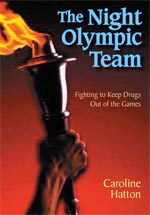
Did you know that at every Olympics, scientists work behind the scenes? I’m one of them! And I’m a writer, too. As a science writer, I wrote a book about it.
As a scientist (I'm a pharmacist and analytical chemist), I’ve been at three Olympics, working on the lab team. We test athletes’ samples for performance-enhancing drugs that are prohibited because taking them is doping. It’s cheating, it can be dangerous to health, and it’s contrary to the spirit of sports. The most talked-about doping agents are anabolic steroids, but there are many more.
At the 2002 Winter Olympics in Salt Lake City, we were testing samples night after night. We never knew what would happen next. Any sample could contain a drug. Reporting it would get the athlete punished.
After we did find a drug in a sample, we spent hours double checking, asking ourselves, “How can we be sure that the test result is correct?” Lots of what if exercises and discussions.
To grow the article into a book, I interviewed the key players. I wrote about their childhoods, career paths, and role in the Olympic story. I inserted each player’s details after the first time he or she appeared in the book manuscript. This took me a year and a half.
And just as I was finally getting this longer version done, a doubt surfaced in my mind. This doubt turned out to be a good question.
Which would be better? A longer book including key players’ profiles or a shorter book without them?
This was the most important decision I faced while writing the book.
The longer book would let readers dig deeper. The shorter book would be quicker and easier to read. My writing buddies, as well as famous author Caroline Arnold all agreed that a shorter book would appeal to more readers.
I decided to shorten the book. I couldn’t simply go back to the article version, which filled only five magazine pages. A book needed some details about the key players’ roles and background. After spending a year and a half writing the long version, it took me only two weeks to shorten it.
How exactly did I do it? I spread the pages on the floor and crossed out the characters’ profiles with a big marker. Then I entered the changes in my Word file and reprinted it. The next day, I read what I got. It felt like reading the bare bones of the story, like sitting down for a meal but being served only the bones of a fish. I had cut way too much. What to do? Add bits and pieces back in one by one, or start over?
I started all over. This time I cut more gingerly, down to half of the original length. Then I split the story into nine chapters.
Next came the most fun part: writing the transitions between chapters! Each chapter ends at a place that leaves readers wanting to know what happens next. Each chapter then has a fact box packed with extra info. I needed to make sure that when readers turned the page and began to read the next chapter, they would know where they were in the story. Writers must figuratively take readers by the hand and never let go, so they don’t get lost. The first sentence of chapters 2 to 9 takes care of that. Those sentences were the last thing I wrote. Perhaps it was the most fun because it was quick and easy. Perhaps it was because the book was finally done, done, done!
And that’s the version that was published with minor changes.
• For a “glimpse” at how my editor and I came up with the book subtitle, "Fighting to Keep Drugs Out of the Games," click here.
• For a ton of links about science writing, scroll down to LINKS AND MORE after you click here.
As a scientist (I'm a pharmacist and analytical chemist), I’ve been at three Olympics, working on the lab team. We test athletes’ samples for performance-enhancing drugs that are prohibited because taking them is doping. It’s cheating, it can be dangerous to health, and it’s contrary to the spirit of sports. The most talked-about doping agents are anabolic steroids, but there are many more.
Red blood cells
Blood doping is prohibited in many sports
At the 2002 Winter Olympics in Salt Lake City, we were testing samples night after night. We never knew what would happen next. Any sample could contain a drug. Reporting it would get the athlete punished.
After we did find a drug in a sample, we spent hours double checking, asking ourselves, “How can we be sure that the test result is correct?” Lots of what if exercises and discussions.
Drawing of a molecule of EPO.
EPO is a blood-booster drug prohibited in sport.
That night, ideas were flying around like sparks between four of us. The rush of excitement made me leap off my chair and pace all over the room, feeling ready to burst. I was thrilled—as a scientist and as a writer. That’s when I thought, “Some day, I will write this story for young readers.”
So I did! I wrote an article, “The Night Olympic Team.” Cricket magazine published it first, then The School Magazine in Australia and YES Mag, the Canadian science magazine for young readers.
And just as I was finally getting this longer version done, a doubt surfaced in my mind. This doubt turned out to be a good question.
Which would be better? A longer book including key players’ profiles or a shorter book without them?
This was the most important decision I faced while writing the book.
The longer book would let readers dig deeper. The shorter book would be quicker and easier to read. My writing buddies, as well as famous author Caroline Arnold all agreed that a shorter book would appeal to more readers.
I decided to shorten the book. I couldn’t simply go back to the article version, which filled only five magazine pages. A book needed some details about the key players’ roles and background. After spending a year and a half writing the long version, it took me only two weeks to shorten it.
How exactly did I do it? I spread the pages on the floor and crossed out the characters’ profiles with a big marker. Then I entered the changes in my Word file and reprinted it. The next day, I read what I got. It felt like reading the bare bones of the story, like sitting down for a meal but being served only the bones of a fish. I had cut way too much. What to do? Add bits and pieces back in one by one, or start over?
I started all over. This time I cut more gingerly, down to half of the original length. Then I split the story into nine chapters.
Next came the most fun part: writing the transitions between chapters! Each chapter ends at a place that leaves readers wanting to know what happens next. Each chapter then has a fact box packed with extra info. I needed to make sure that when readers turned the page and began to read the next chapter, they would know where they were in the story. Writers must figuratively take readers by the hand and never let go, so they don’t get lost. The first sentence of chapters 2 to 9 takes care of that. Those sentences were the last thing I wrote. Perhaps it was the most fun because it was quick and easy. Perhaps it was because the book was finally done, done, done!
And that’s the version that was published with minor changes.
This post is adapted from part of an interview of mine by Beckie Weinheimer, author of the novel, Converting Kate.
Caroline Hatton and Beckie Weinheimer
LINKS
• Book writers often cut big chunks out of manuscripts to shape their books. Those parts can become short stories or articles in magazines, chapters in new books, or blog posts. Three profiles that I cut from The Night Olympic Team are posted at this blog, to show glimpses of the childhoods and career paths of key players in the book: click here, here or here to read them.
• For a ton of links about science writing, scroll down to LINKS AND MORE after you click here.
April 8, 2011
Follow a computer graphic artist illuminating the movie “WALL•E” – a STEM career glimpse and puzzle
Have you seen "Brave," "Up," or "WALL•E"?
Think about your favorite one. Were you swept away?
Artists hand-sketch a comic-book version--the "storyboards." Actors record the characters' voices, reading scripts and improvising. The editorial team puts together storyboards and voices to create a draft--the reels of the film's sequences. .
Think about your favorite one. Were you swept away?
You probably didn't stop to think of this while enjoying the movie, but it was created from scratch, image after countless image, frame by frame, by artists using complex computer programs.
And those programs are used and developed by people like Danielle Feinberg, a Director of Photography for Lighting at Pixar. When asked what she loves best, computers or art, her answer is, "programming computers to create awesome art work!" Danielle is one of several hundred team members who bring these movies to a theater near you.

And those programs are used and developed by people like Danielle Feinberg, a Director of Photography for Lighting at Pixar. When asked what she loves best, computers or art, her answer is, "programming computers to create awesome art work!" Danielle is one of several hundred team members who bring these movies to a theater near you.

Danielle Feinberg
To make a computer animated (or "digitally animated") movie, creators first dream up the story and "pitch it"--they talk big shots into seeing the possibilities. Next, they put it in writing in a short "story treatment."
Artists hand-sketch a comic-book version--the "storyboards." Actors record the characters' voices, reading scripts and improvising. The editorial team puts together storyboards and voices to create a draft--the reels of the film's sequences. .
The art department creates, with pencils, paintbrushes, paper and also computers, art work to describe the look and feel of the characters and their world. Soon everyone uses computer software to do each step. .
Model builders build the characters, sets and props in the computer as 3D (3-dimensional) objects, plotting points using the X, Y and Z axes. Modelers and articulators add controls that act like hinges so they can move parts like elbows or doors. .
The layout crew places the characters and camera in the world, and designs each camera move (or "shot"). Like puppeteers, animators create movements and facial expressions. They let the computer do the "in-betweening," filling in the movement between frames. .
Clap! Bang! Boom! From the beginning to the end of the whole process, the editorial team rearranges the shots, and adds music and sound effects to create the ever-evolving, current version of the movie. .
Shaders added to all the objects describe color, texture and how the material interacts with light (reflective, translucent, dull, etc.). Visual Special Effects artists use all kinds of physics to create fire, explosions, mist and more. The lighting team adds virtual lights and reflections that support the mood and story, and reveal the emotions in each scene. .
Finally, the rendering team sends the files that contain all of this information off to a giant "farm" of computers, where millions of calculations are done to create each pixel on every frame of the final movie. .
Imagine stopping the movie on one image or frame. As Danielle explains, a computer image is made up of over 1.5 million pixels. Think of one pixel on WALL•E's face. It's yellow because that's WALL•E's color. But if the sun is shining from the right and it's late in the day and a reflection is hitting him right at that pixel while the wind is blowing dust around, all these factors are going to affect the exact shade of yellow of that pixel, including in relationship to other pixels around it. The computer must do billions of calculations to take into account all those subtle effects--pixel by pixel, frame by frame, 24 frames per seconds, some 90 minutes per film. .
And the computer software is used, cajoled, finessed, and sometimes even "tricked" by Danielle and her team to create these images that make up a film. .
How exactly does Danielle do it? From one of the three computers at her desk, Danielle picks a shot or series of shots (a "sequence") to work on. She retrieves from the Pixar network all the information ("data") created by everyone else so far, about sets, characters, camera, animation and materials. She looks at the image ("direction") from the art department that shows the time of day, weather or mood of the lighting. Then she adds lights into the 3D world inside the computer, using 30 or 40 controls over each light (the sun, a lamp, reflections...) to build up the image to look like the art reference.
Each morning, Danielle reviews the results of her work by watching the overnight "renders"--a single frame takes hours of computer calculations to render, anywhere from a couple of hours to 90 hours or more in extreme cases. She adjusts the lighting to get closer and closer to the desired look, and fixes the myriad of technical issues that can crop up in the complex software. This takes a week to a month or more depending on how big a chunk of movie she's working on. Danielle and the lighting artists each sit down with the director (who is responsible for the creative content) to show him or her their work, hoping for a "Final!" from the director, meaning that their work on that shot is done and ready to go into the movie.
PUZZLE: Can you spot WALL•E in the frame below, shown before lighting?
She also works with her team to come up with new ways to create what each film needs, such as how to make the world look like it's underwater for "Finding Nemo" or how to create a messy, polluted, dusty world in "WALL•E." Using physics, geometry, a lot of math, and computer programming skills, Danielle and the other animation scientists add to the software for each movie. They make each new world or character possible.
And so from one Pixar team to the next, step by painstaking, exhilarating step, vibrant characters and exotic worlds burst alive.
And so from one Pixar team to the next, step by painstaking, exhilarating step, vibrant characters and exotic worlds burst alive.Finally, photoscientists record the movie in a form that can be played in the theater, as well as on televisions, computers, and mobile screens.
Then, images brimming with light tell you a story, make you gasp, laugh, or blink away tears. And now you know how, with math and science and a lot of heart, Danielle makes it happen, lighting the way on screen and in real life.
ABOUT DANIELLE FEINBERG
Director of Photography - Lighting
Pixar Animation Studios
* Danielle began her career at Pixar Animation Studios in February 1997 as a Render Technical Director (also called a "Render Wrangler") on the feature film "A Bug's Life." She quickly discovered her love for lighting and went on to light many of Pixar's feature films including "Toy Story 2," "Monsters, Inc.," and the Academy Award(R)-winning "Finding Nemo," "The Incredibles" and "Ratatouille." Danielle worked as the Director of Photography for Lighting on another Oscar(R)-winning feature, "WALL•E," and is now working on the look for her next project, Disney•Pixar's 2012 summer release, "Brave."
* Danielle's love of combining computers and art began when she was eight years old, and first programmed a logo turtle to create images. This eventually led her to a Bachelor of Arts in Computer Science from Harvard University. Now, in addition to her Pixar work, she works with teenage girls, encouraging them to pursue math and science by demonstrating to them the same beautiful simplicity she found with the programmed art of the Logo turtle. .
inspires girls to follow their dreams at a Tech Trek science camp.
* When Danielle is not working, she loves to travel, shoot photographs, and play sports like flag football.
LINKS AND MORE
* See Danielle when she was in elementary school.
* Watch Danielle talk about the making of "WALL•E" on the DVD Bonus Features (Disc 2, Behind the Scenes, "The Imperfect Lens").
* Another interesting "WALL•E" DVD bonus feature is "Life of a Shot."
* Take a video tour of Pixar, complete with a giant poofy armchair and play areas.
* See profiles, art work, and interviews of artists such as animators, a director of photography, and a sculptor who work at Pixar.
* See the different looks created by software for... trash in "WALL•E."
* Visit Tribeca Flashpoint Academy, a Digital Media Arts College in Chicago. It offers two-year college degrees to train arts or entertainment professionals to work on computer-based specialties such as games, recording, or animation. Tribeca Flashpoint also offers an abbreviated, Digital Bootcamp program for high school students grades 10 through 12. Students experience a taste of Tribeca Flashpoint's program and complete one portfolio piece.
* Create your own animated film. The New York Film Academy Summer Film and Acting Camps for teens and tweens include 3D Computer Animation Camps in New York City and at Harvard University. Students with little or no experience learn how to build objects and creatures, animate them, and add color, light, and sound, to create their own short film!
* For creative kids who love computers: look at the Digital Media Academy teen summer camps. The filmmaking camp helps you start your career in the movie business by learning scriptwriting, storyboarding, editing, visual effects, and more.
* iD Tech Camps include 3D Computer Animation summer camps, where you can create your own characters and bring them to life, then take home a portfolio and a trial version of the software.
Updated on July 13, 2012
* Create your own animated film. The New York Film Academy Summer Film and Acting Camps for teens and tweens include 3D Computer Animation Camps in New York City and at Harvard University. Students with little or no experience learn how to build objects and creatures, animate them, and add color, light, and sound, to create their own short film!
* For creative kids who love computers: look at the Digital Media Academy teen summer camps. The filmmaking camp helps you start your career in the movie business by learning scriptwriting, storyboarding, editing, visual effects, and more.
* iD Tech Camps include 3D Computer Animation summer camps, where you can create your own characters and bring them to life, then take home a portfolio and a trial version of the software.
Updated on July 13, 2012
March 24, 2011
They reached for the stars
Women at NASA : videos and essays about dozens of them, how they pursued their dreams, overcame obstacles, and now play a vital role.
Labels:
aerospace,
girls,
high school,
middle school,
science,
Tech Trek
February 28, 2011
From the classroom to outer space
.
If you're not sure what science classes can do for you, read Natalie Batalha's recollections of how she began to discover her own strengths once she enrolled in a physics course in college. It made her realize how much she loved science.
.
From that point on, her passion and career skyrocketed. Today she's an astronomer on the NASA team assigned to the Kepler mission: searching for Earth-like planets.
.
.
Watch Natalie at work in this video, in which she and other astronomers explain the Kepler mission. Its key scientific instrument is a space telescope. Since it was launched in March 2009, it has allowed researchers to detect hundreds of planets that might be Earth-like.
.
At the end of the video, Natalie proudly announces a historical milestone: on January 10, 2010, the Kepler team detected the first rocky planet orbiting a star other than our sun.
.
.
A vision by artist Dana Berry
.Although it's too hot to support life, the discovery of a rocky planet (as opposed to, say, a gas planet) is extraordinarily significant because a rocky planet might host life. On a rocky planet, the most important requirement for life as we know it, liquid water, can pool and gather the substances that life needs.
.
And so the scientists keep on searching for answers to soul-stirring questions. Are we alone? Or are there other Earths out there?
.
LINKS AND MORE
* Hear Natalie's thoughts on the historical rocky planet discovery, in this video.
.
* See a movie about Natalie's career path.
.
* Read a brief description of astronomy.
* Go on a virtual field trip to the Palomar Observatory in California.
.
* FAQ for high school students.
.
* "The Ultimate Astronomy Career Guide" is an annotated compilation of carefully selected links to excellent career guides, overviews, interviews, day-in-the-lie, articles, and info on specialties.
.
* Reference for the details in this post about rocky planets, and a great read: Planet Hunter - Geoff Marcy and the Search for Other Earths by Vicki Oransky Wittenstein.
.
Geoff Marcy is one of the Kepler astronomers. He appears in the video about the mission.
.
* Listen to podcasts by astronomers about lots of topics such as multiples universes, our explosive sun, black holes, and more. This is offered by the Astronomy Society of the Pacific.
.
* Listen to podcasts by astronomers about lots of topics such as multiples universes, our explosive sun, black holes, and more. This is offered by the Astronomy Society of the Pacific.
Updated October 8, 2011
Labels:
career path example,
girls,
high school,
middle school,
Natalie Batalha,
science,
STEM,
Tech Trek
Subscribe to:
Posts (Atom)