 |
| Seismogram of Aug 23, 11 earthquake that shook east coast of U.S. |
Showing posts with label career path example. Show all posts
Showing posts with label career path example. Show all posts
January 30, 2012
Meet a world-class earthquake expert


January 19, 2012
More on pharmacy as a career

Watch videos about pharmacy as a career at the website, Pharmacy is Right for Me.
For more, go to my initial pharmacy blog post, "Follow a hospital pharmacist," and don't forget to scroll down to the links at the bottom.
January 13, 2012
The unstoppable girl scientist
The absolutely amazing high school senior Samantha Garvey is a semifinalist in the prestigious Intel science competition! No matter what happens, she's going to college. Meet her in this news clip.
February 28, 2011
From the classroom to outer space
 .
.
If you're not sure what science classes can do for you, read Natalie Batalha's recollections of how she began to discover her own strengths once she enrolled in a physics course in college. It made her realize how much she loved science.
.
From that point on, her passion and career skyrocketed. Today she's an astronomer on the NASA team assigned to the Kepler mission: searching for Earth-like planets.
.
.
 .
.
Watch Natalie at work in this video, in which she and other astronomers explain the Kepler mission. Its key scientific instrument is a space telescope. Since it was launched in March 2009, it has allowed researchers to detect hundreds of planets that might be Earth-like.
.
At the end of the video, Natalie proudly announces a historical milestone: on January 10, 2010, the Kepler team detected the first rocky planet orbiting a star other than our sun.
.
.
 Kepler 10-b, the first rocky planet orbiting a start other than our sun
A vision by artist Dana Berry
.Although it's too hot to support life, the discovery of a rocky planet (as opposed to, say, a gas planet) is extraordinarily significant because a rocky planet might host life. On a rocky planet, the most important requirement for life as we know it, liquid water, can pool and gather the substances that life needs.
.
And so the scientists keep on searching for answers to soul-stirring questions. Are we alone? Or are there other Earths out there?
.
LINKS AND MORE
* Hear Natalie's thoughts on the historical rocky planet discovery, in this video.
.
* See a movie about Natalie's career path.
.
* Read a brief description of astronomy.
* Go on a virtual field trip to the Palomar Observatory in California.
* Go on a virtual field trip to the Palomar Observatory in California.
.
* FAQ for high school students.
.
* "The Ultimate Astronomy Career Guide" is an annotated compilation of carefully selected links to excellent career guides, overviews, interviews, day-in-the-lie, articles, and info on specialties.
.
* Reference for the details in this post about rocky planets, and a great read: Planet Hunter - Geoff Marcy and the Search for Other Earths by Vicki Oransky Wittenstein.
.
 .
.
Geoff Marcy is one of the Kepler astronomers. He appears in the video about the mission.
.
* Listen to podcasts by astronomers about lots of topics such as multiples universes, our explosive sun, black holes, and more. This is offered by the Astronomy Society of the Pacific.
.
* Listen to podcasts by astronomers about lots of topics such as multiples universes, our explosive sun, black holes, and more. This is offered by the Astronomy Society of the Pacific.
Updated October 8, 2011
February 14, 2011
Guess who this girl grew up to be in my book, The Night Olympic Team
Readers of my science book, The Night Olympic Team, ask me for glimpses of the childhood and career path of key players in the book. Here's another one. .

Doesn't she look like she was born to play? .
Her science career started with a bang! At age twelve, she and a friend combined all of the glassware and products from their two chemistry sets, then heated the flasks to make something happen. Multicolor products started racing around. Bubbles overflowed. Then... BOOM! It splattered stinky brown ooze everywhere. Both girls let out a gasp and a giggle. There were no casualties, except for the kitchen, which had to be repainted. The girls got in big trouble for their recklessness. They could have been injured or even killed. .
As a kid growing up in France, she loved to read about biology to learn how living things work. She went to medical school to learn how the numan body can get out of whack and get sick, and how to fix it. skip line . . She signed up to do a research project. She was scared, because everything was new to her, but she did O.K. and she liked working in a lab. By the time she became a doctor, she had published her first scientific article in an international journal. skip line. .
  She never became the kind of doctor who sees patients. Instead, she did research. Her task was always to make a lab test work. But in truth, "All the science work I've ever done was to satisfy my hunger for play," she says. "I love to play computer sleuthing games, to figure out whodunit in crime novels, and recently I developed a passion for genealogy [that's family tree science], which is detective work into the past." . .
  WHO IS SHE? . .
* Caroline Hatton (that's me, your blogger), scientist (I help test athletes for prohibited performance-enhancing drugs) and author of The Night Olympic Team? . . * Francoise Lasne [pronounced fran-swahz lahn], scientist, who perfected a test to find prohibited drugs in athletes' samples? . .
  IF YOU GUESSED FRANCOISE LASNE, YOU WERE RIGHT! . .
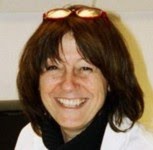
  She's a scientist who catches sports cheaaters nd defends honest athletes who compete drug-free. Read about her work in the book, The Night Olympic Team. She is the current Director of the French national anti-doping laboratory (AFLD Departement des analyses). .
.

Doesn't she look like she was born to play? .
Her science career started with a bang! At age twelve, she and a friend combined all of the glassware and products from their two chemistry sets, then heated the flasks to make something happen. Multicolor products started racing around. Bubbles overflowed. Then... BOOM! It splattered stinky brown ooze everywhere. Both girls let out a gasp and a giggle. There were no casualties, except for the kitchen, which had to be repainted. The girls got in big trouble for their recklessness. They could have been injured or even killed. .
As a kid growing up in France, she loved to read about biology to learn how living things work. She went to medical school to learn how the numan body can get out of whack and get sick, and how to fix it. skip line . .
 She signed up to do a research project. She was scared, because everything was new to her, but she did O.K. and she liked working in a lab. By the time she became a doctor, she had published her first scientific article in an international journal. skip line. . She never became the kind of doctor who sees patients. Instead, she did research. Her task was always to make a lab test work. But in truth, "All the science work I've ever done was to satisfy my hunger for play," she says. "I love to play computer sleuthing games, to figure out whodunit in crime novels, and recently I developed a passion for genealogy [that's family tree science], which is detective work into the past." . . WHO IS SHE? . .
 * Caroline Hatton (that's me, your blogger), scientist (I help test athletes for prohibited performance-enhancing drugs) and author of The Night Olympic Team? . .
* Francoise Lasne [pronounced fran-swahz lahn], scientist, who perfected a test to find prohibited drugs in athletes' samples? . . IF YOU GUESSED FRANCOISE LASNE, YOU WERE RIGHT! . . She's a scientist who catches sports cheaaters nd defends honest athletes who compete drug-free. Read about her work in the book, The Night Olympic Team. She is the current Director of the French national anti-doping laboratory (AFLD Departement des analyses). ..
January 12, 2011
Guess who this kid grew up to be in my book, The Night Olympic Team
Readers of my science book, The Night Olympic Team, ask me for glimpses of the childhood and career path of the key players in the book. Here's one.
.
They could not keep him from tinkering forever. When he was in third grade, he walked past their hobby shop on the way to school. What he wanted was not model airplanes, but the vials lined up on a shelf, full of colorful stuff: salts, minerals, chemicals. He knew they would make for great experiment. He asked the shop people "how to make something cool happen--catch on fire, maybe blow up?" But instead of helping him, they refused to sell vials to him. Imagine that!
.
 .
.
Despite this setback, he grew up to be a scientist who would use recombinant DNA technology (a way to cut and paste DNA) to invent a supermedicine. While in college at the University of California at Irvine, he fell in love with DNA. He thought, "Cool! That's what I want to do. Work on that."
.
 .
. .
. .
.
By trailblazing where nature had no plans to go, he made something cool happen for millions of patients.
.
WHICH ONE OF THE KEY PLAYERS IN THE NIGHT OLYMPIC TEAM IS HE?
.
In order of appearance:
.
Jeff Gorzek, scientist, who tests athletes' samples for prohibited drugs?
.
Don Catlin, scientist and lab director, whose team found a prohibited drug in athletes' samples? The drug was a blood-booster medicine invented to treat medical patients, not to help healthy athletes cheat by boosting their endurance!
.
Steve Elliott, scientist, who invented the medicine?
.
Jacques Rogge, President of the International Olympic Committee?
.
Jan Paulsson, lawyer?
.
Zac Douglas, lawyer?
.
IF YOU GUESSED STEVE ELLIOTT, YOU WERE RIGHT!
.
Steve is a Scientific Director at Amgen, a therapeutics company in Thousand Oaks, California. He worked on EPO, the body's natural blood-boosting hormone. He led the team that invented NESP (also called Aranesp or darbepoetin alfa), a longer-lasting version of EPO. He plays a key role in The Night Olympic Team.
.
MORE ABOUT STEVE
.
Steve loves to play golf... before going to work.
.
They could not keep him from tinkering forever. When he was in third grade, he walked past their hobby shop on the way to school. What he wanted was not model airplanes, but the vials lined up on a shelf, full of colorful stuff: salts, minerals, chemicals. He knew they would make for great experiment. He asked the shop people "how to make something cool happen--catch on fire, maybe blow up?" But instead of helping him, they refused to sell vials to him. Imagine that!
.
 .
.Despite this setback, he grew up to be a scientist who would use recombinant DNA technology (a way to cut and paste DNA) to invent a supermedicine. While in college at the University of California at Irvine, he fell in love with DNA. He thought, "Cool! That's what I want to do. Work on that."
.
 .
.He started doing research for the professor who had inspired him. He earned a bachelor's degree in biological sciences, then a doctoral degree in molecular biology and biochemistry. For years afterwards, he studied how DNA programs a cell's life and death.
.
.
He went to work for a company which uses biotechnology (one kind of DNA science) to discover medicines to improve people's lives. He started to do research on a protein that's a natural hormone in the body. Soon the company began selling as a medicine an artificial version of the hormone.
.
.
Then there was no need to do research on it any more, right? Wrong! Our mystery man explains why his company continued to study the medicine: "Here we market this wonder drug--we simply must know all about it, understand everything about it."
.
Working on this medicine year after year, he could picture every bit of it in his sleep. Studies showed that the more sugars on the molecule, the better it worked. Logically, our mystery man set out to put as many sugars as he could fit on the molecule, and began creating new versions of the medicine.
.
 .
.Some said, "It won't work." Their thinking was that nature had improved this hormone for millenia. Nature had already made the hormone the best it could be. How could humans possibly make it better?
.
Our mystery man said, "How do you know unless you try?"
.
For a kid not allowed to tinker with colored powders, he was having some fun now. He made hundreds of new versions.
.
He worked on the project after hours, on the side, because it was not a "sanctioned" (official) project. His company already made the wonder medicine of all ages. What could top that? Why bother to try? Especially he, who was already a successful scientist by any measure imaginable--working at a world-famous company, published, respected. But he was determined. His enthusiasm got others interested in helping him. They also stayed after hours, testing each new version. Some didn't work, but some worked better, one of them especially.
.
He had succeeded at what some said was impossible. He had created a supermedicine that lasted longer in the body.
.
How had a human mproved upon something that nature had already improved over millenia? Nature refined the hormone to be made whenever the body needs it. The difference with its use as a medicine is that patients get shots. Fewer shots are possible because the benefits last longer--and that makes life easier for the patient. Not bad for a medicine that Steve was not supposed to work on officially.
.
From his lab freezer, he pulls out a white plastic tray packed with vials--his very own grownup collection. "Mutants," he says, his voice resonating with pride. In the palm of one hand, he holds the fruits of years of labor.
.
 .
.By trailblazing where nature had no plans to go, he made something cool happen for millions of patients.
.
WHICH ONE OF THE KEY PLAYERS IN THE NIGHT OLYMPIC TEAM IS HE?
.
In order of appearance:
.
Jeff Gorzek, scientist, who tests athletes' samples for prohibited drugs?
.
Don Catlin, scientist and lab director, whose team found a prohibited drug in athletes' samples? The drug was a blood-booster medicine invented to treat medical patients, not to help healthy athletes cheat by boosting their endurance!
.
Steve Elliott, scientist, who invented the medicine?
.
Jacques Rogge, President of the International Olympic Committee?
.
Jan Paulsson, lawyer?
.
Zac Douglas, lawyer?
.
IF YOU GUESSED STEVE ELLIOTT, YOU WERE RIGHT!
.
Steve is a Scientific Director at Amgen, a therapeutics company in Thousand Oaks, California. He worked on EPO, the body's natural blood-boosting hormone. He led the team that invented NESP (also called Aranesp or darbepoetin alfa), a longer-lasting version of EPO. He plays a key role in The Night Olympic Team.
.
MORE ABOUT STEVE
.
Steve loves to play golf... before going to work.
Subscribe to:
Posts (Atom)