Showing posts with label pharmacist. Show all posts

January 19, 2012

More on pharmacy as a career


1072647

Watch videos about pharmacy as a career at the website, Pharmacy is Right for Me.

For more, go to my initial pharmacy blog post, "Follow a hospital pharmacist," and don't forget to scroll down to the links at the bottom.

May 18, 2011

Top pay for girls

To help pick the right career for you, find out how much money you’re likely to make.

The article, “The Best-Paying Jobs For Women in 2011,” ranks the ten top-paying jobs for women in 2010.

Look at the graph below. It represents those ten top-paying jobs.

Each job is shown as a stack of coins. The more coins, the more pay.

The gold coins are STEM (Science, Technology, Engineering, or Math) careers. How many of the top-paying careers for women are STEM careers?

BEST-PAYING JOBS FOR WOMEN

The STEM career women who are paid the most are… physicians and surgeons! The close seconds are pharmacists.

LINK

For a quick-and-easy overview of physician and surgeon careers, listen to the podcast at the Sloan Career Cornerstone Center. It’s an introduction to the required schooling, a day-in-the-life of a physician or surgeon, salary info, where physicians or surgeons work, and how their employment will grow much faster than in other professions.


May 6, 2011

Follow a science writer shaping a book – a STEM career glimpse

Did you know that at every Olympics, scientists work behind the scenes? I’m one of them! And I’m a writer, too. As a science writer, I wrote a book about it.

As a scientist (I'm a pharmacist and analytical chemist), I’ve been at three Olympics, working on the lab team. We test athletes’ samples for performance-enhancing drugs that are prohibited because taking them is doping. It’s cheating, it can be dangerous to health, and it’s contrary to the spirit of sports. The most talked-about doping agents are anabolic steroids, but there are many more.

Red blood cells
Blood doping is prohibited in many sports

At the 2002 Winter Olympics in Salt Lake City, we were testing samples night after night. We never knew what would happen next. Any sample could contain a drug. Reporting it would get the athlete punished.

After we did find a drug in a sample, we spent hours double checking, asking ourselves, “How can we be sure that the test result is correct?” Lots of what if exercises and discussions.


Drawing of a molecule of EPO.
EPO is a blood-booster drug prohibited in sport.

That night, ideas were flying around like sparks between four of us. The rush of excitement made me leap off my chair and pace all over the room, feeling ready to burst. I was thrilled—as a scientist and as a writer. That’s when I thought, “Some day, I will write this story for young readers.”


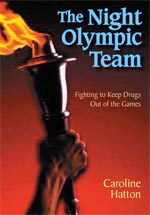
So I did! I wrote an article, “The Night Olympic Team.” Cricket magazine published it first, then The School Magazine in Australia and YES Mag, the Canadian science magazine for young readers.

To grow the article into a book, I interviewed the key players. I wrote about their childhoods, career paths, and role in the Olympic story. I inserted each player’s details after the first time he or she appeared in the book manuscript. This took me a year and a half.

And just as I was finally getting this longer version done, a doubt surfaced in my mind. This doubt turned out to be a good question.

Which would be better? A longer book including key players’ profiles or a shorter book without them?

This was the most important decision I faced while writing the book.

The longer book would let readers dig deeper. The shorter book would be quicker and easier to read. My writing buddies, as well as famous author Caroline Arnold all agreed that a shorter book would appeal to more readers.

I decided to shorten the book. I couldn’t simply go back to the article version, which filled only five magazine pages. A book needed some details about the key players’ roles and background. After spending a year and a half writing the long version, it took me only two weeks to shorten it.

How exactly did I do it? I spread the pages on the floor and crossed out the characters’ profiles with a big marker. Then I entered the changes in my Word file and reprinted it. The next day, I read what I got. It felt like reading the bare bones of the story, like sitting down for a meal but being served only the bones of a fish. I had cut way too much. What to do? Add bits and pieces back in one by one, or start over?

I started all over. This time I cut more gingerly, down to half of the original length. Then I split the story into nine chapters.

Next came the most fun part: writing the transitions between chapters! Each chapter ends at a place that leaves readers wanting to know what happens next. Each chapter then has a fact box packed with extra info. I needed to make sure that when readers turned the page and began to read the next chapter, they would know where they were in the story. Writers must figuratively take readers by the hand and never let go, so they don’t get lost. The first sentence of chapters 2 to 9 takes care of that. Those sentences were the last thing I wrote. Perhaps it was the most fun because it was quick and easy. Perhaps it was because the book was finally done, done, done!

And that’s the version that was published with minor changes.


This post is adapted from part of an interview of mine by Beckie Weinheimer, author of the novel, Converting Kate.

Caroline Hatton and Beckie Weinheimer

LINKS

• Book writers often cut big chunks out of manuscripts to shape their books. Those parts can become short stories or articles in magazines, chapters in new books, or blog posts. Three profiles that I cut from The Night Olympic Team are posted at this blog, to show glimpses of the childhoods and career paths of key players in the book: click here, here or here to read them.

• For a “glimpse” at how my editor and I came up with the book subtitle, "Fighting to Keep Drugs Out of the Games," click here.

• For a ton of links about science writing, scroll down to LINKS AND MORE after you click here.

December 17, 2010

Follow a science writer and editor crafting a book subtitle – a STEM career glimpse

by me, your blogger, Caroline Hatton
.
.
If you love words and science, you can live happily ever after as a science writer.
.
Science can transport me into whole new worlds. So can reading. But when I write, I have the power to take readers into another world.
.

Capturing science book ideas
.
Most science writers are scientists who love writing (like me) or writers who love science.
.
Science writers must be capable of learning about at least one area of science, and they must write well enough to make it clear and infect readers with passion.
.
I have two science degrees: a pharmacist degree and a Ph.D. (Doctor of Philosophy, a doctoral degree) in Chemistry. As a scientist, I help test athletes for performance-enhancing drugs that are prohibited in sports because using them is cheating, it can be dangerous to health, and it's contrary to the spirit of sport.
.
While working at the 2002 Winter Olympics in Salt Lake City, I was on the team of scientists that caught three athletes on a prohibited drug. They had won a total of eight medals. We scientists helped officials and lawyers determine that the right thing was for the athletes to return all their medals, so they could be awarded to the rightful winners.
.
I'll never forget the night, the instant when the thought flashed through my mind, "Some day, I will write this story for children."
.
So I did!
.
My article, "The Night Olympic Team," got published in Cricket in the United States, then in The School Magazine in Australia and YES Mag, a children's science magazine in Canada (under the title, "Finding Gold for Canada").
.
I spent two years growing the article into a book. When I submitted my book manuscript to editors, the title was The Night Olympic Team and the subtitle was Inside a Drug Scandal.
.
For nonfiction books, I like when the title is intriguing and the subtitle crystal clear. That way, the title grabs me and makes me itch with curiosity. But the subtitle had better tell me exactly what the book is about.
.
The Night Olympic Team is a title that I had tried to use since the Fall of 2000. My longtime boss, beloved friend and a pioneer of drug testing in sports, Dr. Don Catlin at the UCLA Olympic Lab where I worked, had just come home from the Summer Olympics in Sydney. He had been asked to write a report for a campus newspaper, UCLA Today.
.
As his ghost writer, I often created drafts for him--internal university memos, manuscripts for scientists, lawyers or lay readers, international correspondence, and proposed protocols and policies for drug testing in sports. My words jumpstarted his thinking. Can you imagine how much more you could get done if someone drafted your homework for you?
.
Sometimes Don Catlin signed the letters I printed for him. Other times he threw out all my words and ideas, and wrote his own piece. Between these extremes, we spent many hours and days of our lives revising, debating, bickering, arguing, or avoiding one another, all for the sake of helping one another and fighting for The Cause--against drugs in sports--to protect the athletes' freedom to compete without taking drugs.
.
For UCLA Today, the report I drafted for Don in 2000 began like this:
.
The night Olympic team
.
The [N]th Olympic Summer Games are over down under. Beneath the exuberance, fanfare and cheer there were discordant notes every time athletes got caught with performance-enhancing drugs in their urine--but we heard so much about positive tests only because the multinational Olympic team at the Sydney laboratory did such a good job finding drugs. The scientists deserve medals, yet the only gold they got came in specimen bottles in the middle of the night.
.
When Don read that last sentence, he humphed, "Gross. No one's going to print anything like it." Although he never submitted my draft for publication, eight years later (in 2008), my book was published with something very much like it on the first page. :-)
.
As for the subtitle, Inside a Drug Scandal, one Friday afternoon in 2007, three months before my book manuscript was to be declared final and sent to the printer, my editor extraordinaire (that's a French word that means that he's a star), Andy Boyles at Boyds Mills Press, e-mailed me about it.
.
His concern was the suggestion that the book might be about "the *latest* drug scandal, whatever that might be years down the road." Prospective buyers night think, "Oh, I just read about that in the Times. No need to buy this book."
.
Andy wanted the subtitle to indicate that the book is not only about one scandal, but also about the general effort to quash the use of drugs in sports. He had spent time trying to come up with ideas and shared a long list of possibilities, including:
.
THE NIGHT OLYMPIC TEAM
.
The lab that fights drugs in sports
.
Keeping drugs out of the Games
.
Fighting drugs in sports
.
.
The following Monday afternoon, I replied by e-mail:
.
How about
.
THE NIGHT OLYMPIC TEAM
.
fighting to free sports from drugs
.
or
.
the untold story of a drug scandal
.
.
Andy sent three new ideas, one of which, "Fighting for Drug-Free Games," he acknowledged to be a bit of a tongue-twister. His e-mail ended with "???"
.
To avoid missing any possibility, I wrote keywords on paper slips and shuffled them, reading the permutations aloud until I got this:
.
.
Then I went to peck on my keyboard:
.
THE NIGHT OLYMPIC TEAM
.
Fighting to Keep Drugs Out of the Games
.
?
.
I liked the ring of it all. It rolled off my tongue easily with no risk of tripping and with a nice, strong beat.
.
I clicked "Send."
.
The phone rang. It was Andy. He wanted to make sure I could live with it.
.
Yes!
.
My book had a title and a subtitle. It was becoming real.
.
This was a milestone in the life of my book, itself a milestone in my life. And it was only the eight-word subtitle of a 6,000-word book! The rest... is another story.
.
.
ABOUT ME, CAROLINE HATTON
.
When I'm not working, I love to make miniatures, quilt, hike, backpack, ride horses, or cross-country ski.
.

.
LINKS AND MORE

* Follow a science writer...

...shaping a book.

...using a motivation trick (telling a friend).

...using a motivation trick (keeping a Hope Journal).

...using a motivation trick (finishing projects before starting new ones)

* Read a paragraph-long description of science writing careers at the Sloan Career Cornerstone Center.

* For an overview, read "Science Careers: Science Writer" at ScienceBuddies.org.
.
* For another overview, read "A Guide to Careers in Science Writing" by the Council for the Advancement of Science Writing.
.
* For a brief overview and paragraph-long profiles of the contributors to the Computing Life website, read "Writing Life" by Emily Carson.
.
* For a thrill, read an article and brief summaries about the winners of the science journalism awards of the American Association for the Advancement of Science.
.
* Read fascinating notes about how award-winning author Caroline Arnold got ideas for her books, such as Global Warming and the Dinosaurs, and about her experiences researching and writing them. She is the author of 150 children's books inspired by her love of nature and by her travels. Many of her books have received awards as science books.
.
* Find out how author Sneed B. Collard III researches some of his science books for older younsters.
.
* Read about how I do research for science writing, in this interview of mine by another author, Vicki Leon:
.
- part 1 about interviewing experts... with more or less success!
.
- part 2 about fact-checking
.
- part 3 about weaving together the scientist's adventures in life and the science
.
* Read a terrific interview of astronomer, teacher, and science writer Alan Hirshfeld (part 1 and part 2) by Vicki Leon.
.
* Get some tips for adult, professional beginners.
.
* For clear, strong advice to help you become a better science writer, read Chapter 15, "Science and Technology," in the book by William Zinsser, On Writing Well - The Classic Guide to Writing Nonfiction. It's one of my favorite chapters in one of my favorite books about writing.
* Read about a job broader than just writing, in the article "Science Communication as a Press Officer" by Christine Pulliam, who has a Master's degree in astronomy.

* For an overview of a related career, Technical Writer, read the ScienceBuddies.org page.
.
Updated March 29, 2012.

July 19, 2010

Behind the scenes at the Olympics - A pharmacist’s story


In the previous post, Peter Ambrose showed you exactly how a hospital pharmacist takes care of a patient. Would you like to know how he, as a pharmacist, got a front row seat at the Olympics… for free? Read about his adventures at the 2008 Summer Olympics in Beijing and see his photos at his blog, “My Olympic Journey.”


ABOUT PETER AMBROSE

When Peter is not helping others as a pharmacist, he loves camping, hiking, fishing, planting flowers and vegetables, and working out with weights. He also enjoys watching many sports, especially from the front row at the Olympics!

July 16, 2010

Follow a hospital pharmacist – a STEM career glimpse

by Peter Ambrose, Pharm.D. (Doctor of Pharmacy)


as told to Caroline Hatton


If you like helping people, you might love to be a pharmacist.

You may have been inside your neighborhood pharmacy, and seen people distribute medicines and give advice from behind a counter. Some of them are pharmacy technicians. One of them is the pharmacist in charge. Such a pharmacist, who works in the community, is called something very clever… a community pharmacist!

But did you know that some pharmacists work in hospitals?

They also distribute medicines. They advise not only sick people (patients), but also doctors and nurses. This is because pharmacists are experts about medicines: what they are, how they work, and how best to use them to help people by curing disease or making life better.

Hospital pharmacists do a large variety of tasks. What might be one of those tasks? How exactly would it get done? To find out, let’s follow one pharmacist. She joins a doctor and nurse at the bedside of a patient, a teen athlete in pain.

The nurse takes the athlete’s temperature. He has a high fever. His right leg is red and swollen.


The doctor has examined him, ordered a pain killer, reviewed lab tests results, and identified (diagnosed) the problem as cellulitis (pronounced SELL-u-LIGHT-iss), an infection under the skin. It is caused by bacteria and can spread among athletes.

The boy’s infection is serious, so the doctor decides to treat it with a powerful medicine called an aminoglycoside (pronounced uh-MEE-no-GLY-coe-side) antibiotic. Like most medicines, it has many effects, some wanted, some not. Giving the patient too much may cause him to go deaf or it may damage his kidneys, which must work properly for him to stay alive and healthy. Too little medicine may not keep the infection from endangering his life.

Someone must take responsibility for figuring out how much medicine the nurse should give the patient. The doctor turns to the pharmacist to ask her to make a plan.

The ball is now in the pharmacist’s court. She knows exactly what to do. First, find out how fast the patient’s body will get rid of the medicine—how well his kidneys are working to remove water, waste, and medicines from his body. A special blood test (serum creatinine concentration) can reveal this.

The pharmacist walks to the pharmacy office closest to this patient’s room. At the computer, she pulls up his personal information (chart) and orders the test. She asks the lab staff to call her as soon as the result is known. A lab team member will come take a blood sample from the patient and bring it back to the lab for testing.

After the pharmacist works on other things for a few hours, her pager beeps: the test result is ready! She reads it in the patient’s chart. She can see his age and weight.

Using a math formula in a computer program she wrote and saved before, she figures out how fast the medicine will flow out through the patient’s kidneys—today. Now the pharmacist can calculate how much medicine to give (the dose) to have, in the patient’s body, the maximum amount that will be safe.

She orders exactly how much the nurse must give and how often, for example “50 milligrams every 8 hours intravenously” (injected in a vein). This is not the same as giving twice as much, half as often, which would not be right for this patient.


The pharmacist also orders more lab tests, to measure the amount of medicine in the blood, at its highest (half an hour after the patient received it) and lowest (half an hour before the next dose). She asks the lab team to take the blood samples at specific times.

For days, ten or more if necessary, the pharmacist follows this boy’s treatment. She keeps adjusting the dose, based on blood levels, kidney function, the nurse’s reports, and the doctor’s lead. Her calculations help the treatment work better so the patient can go home several days earlier.

The pharmacist is a key member of the health team. So is the patient, following orders and maintaining a winning attitude.

This may sound like walking a tightrope, hand in hand with the patient. Team work makes it a thrill and a triumph, every step of the way. And this is only one of many things that pharmacists work on with others.

ABOUT PETER AMBROSE

Peter is a hospital pharmacist, a Doctor of Pharmacy, and a Professor of Clinical Pharmacy at the School of Pharmacy of the University of California at San Francisco. As an enthusiastic teacher, he’s shared his wisdom and experience with students as far as his hometown of Long Beach (California), nearby Los Angeles, and Tokyo. As a sports fan, he’s had adventures that not many pharmacists have experienced: follow him behind the scenes at the Olympics.

LINKS

* Watch a video about hospital and health system pharmacists who LOVE their jobs.

* For more about what is uniquely exciting about hospital pharmacists’ careers, how they spend their work time, and what they like best and least, read the first two pages of these survey results.

* About pharmacists

Hospital pharmacists do what Peter described and much more. They tend to find their work life varied, challenging, and satisfying. Community pharmacists spend most of their time helping patients, making a difference one person at a time. Pharmacists can also choose careers in industry or government, research or business, even sports. Pharmacists have among the highest starting salaries of college graduates in the U.S.

* For a quick-and-easy overview of pharmacist careers, click on "Listen to the podcast..." at the Sloan Career Cornerstone Center. It’s an introduction to the required schooling, a day-in-the-life of a pharmacist, salary info, where pharmacists work, and the fantastic job market in the years ahead.

* For another friendly overview, visit ScienceBuddies.org.

* Is pharmacy right for you? Get help finding the answer at the website, "Pharmacy is Right for Me".

* Watch videos of pharmacist Kate James:

- on why to become a pharmacist (hint: Kate loves science and people)

- on how much money pharmacists make

- on how to become a pharmacist

- on the pros and cons of a pharmacy career

* Read an interview of a research pharmacist (why she chose her career, her workday, what she likes best and least about work, career goals, hobbies). 

* Pharmacist was the second-best-paid job for women in 2011.

Updated January 18, 2012

July 14, 2010

Top pay for girls

To help pick the right career for you, find out how much money you’re likely to make.

The article, “Best-Paying Jobs For Women,” ranks the ten top-paying jobs for women who worked full time in 2009.

Look at the graph below. It represents those ten top-paying jobs.

Each job is shown as a stack of coins. The more coins, the more pay.

The gold coins are STEM (Science, Technology, Engineering, or Math) careers. How many of the top-paying careers for women are STEM careers?

BEST-PAYING JOBS FOR WOMEN


The STEM career that pays women the most is… pharmacist! And job opportunities for pharmacists are expected to grow faster than for most other careers until at least 2018.

LINKS

● For a quick-and-easy overview of pharmacist careers, click on "Listen to the podcast..." at the Sloan Career Cornerstone Center. It’s an introduction to the required schooling, a day-in-the-life of a pharmacist, salary info, where pharmacists work, and the fantastic job market in the years ahead.

● Read an interview of a research pharmacist (why she chose her career, her workday, what she likes best and least about work, career goals, hobbies).

July 9, 2010

A STEM Careers Blog. Why now? Why me?

Because in July 2010, I will appear once more at Tech Trek, the math/science camps for 7th-grade girls. Trekkers, it’s for you that I launch this blog now.

I get invited because I’m a scientist. At Tech Trek, I join the Professional Women’s Night, when campers meet women who are math or science professionals, and I make presentations. For this I thank the camp directors, Carol Holzgrafe and Colleen Briner-Schmidt, a science teacher.

As a scientist, I help test athletes for prohibited performance-enhancing drugs, such as anabolic steroids. I’ve worked at three Olympics.

One year at Tech Trek, Colleen the science teacher asked me whether I’d had to surmount obstacles to become a scientist because I’m a woman; whether as a girl, I was ever discouraged from being a scientist. Were there few women scientists around, if any, when I was young?

No, no, and no! Quite the contrary. My mother was a pharmacist like my father. I knew many women who were pharmacists or medical doctors, and one who was a physics researcher.

Plus, every day on my way to school in Paris (France) where I grew up, I walked past a building…


…with a stone plaque on the wall that said, “Here, Marie Curie discovered radium.”


Marie Curie was a scientist. She discovered radium and polonium, two chemical elements, and studied the kinds of rays of energy or particles they give off, or radioactivity. As a result, our understanding of matter and energy, and science itself changed forever. Marie Curie won two Nobel Prizes for her work.
So I always knew that women could be scientists.

Speaking of role models, Colleen the science teacher knows a boy who, when he was five years old, loved to watch Sesame Street. Astronaut Sally Ride appeared on it. He loved her, and oh he would’ve loved to be an astronaut, but he didn’t think he could, because he thought it was a woman’s job.

Of course, that’s not true, and the boy soon learned this. Astronauts are chosen for what they can do. It doesn’t matter if they’re men or women.

Isn’t it amazing what we think we can or cannot do, what we’re even capable of imagining, depending on what we experience as we grow up?

So I start this blog to help girls and boys unleash their imaginations and potential, by helping them follow STEM professionals at work, do fun activities, and link to valuable resources.

LINKS

● For more on Marie Curie, such as tons of details, photos, and quotes from her autobiographical notes, see “Marie Curie and the science of radioactivity” by the American Institute of Physics - Center for the History of Physics.

● Read a Smithsonian Magazine article on Marie Curie's passion for science, despite the barriers she faced because she was a woman.


● A new play, Radiance: The Passion of Marie Curie, written by the actor and director Alan Alda, debuts November 9, 2011. Read his interview.

● What are some of the careers that match your interests and favorite school subjects? Find out at this career info site. Examples of STEM careers are under Math, Science, Computers, Managing Money, and several other subjects.

● If you are curious about a particular STEM career and would like a quick-and-easy overview, look for that career at the Sloan Career Cornerstone Center and click on "Listen to the podcast..." about it. For example, the Veterinarian podcast offers a rounded overview of the profession, the required schooling, specialties, a day-in-the-life of a veterinarian, salary info, where veterinarians work, and the awesome job market in the years ahead.

Back to blog

Updated November 9, 2011

June 22, 2010

About me

My name is Caroline Hatton. I’m a scientist and an author of books for young readers.

As a sports anti-doping scientist, I help test athletes for prohibited performance-enhancing drugs such as anabolic steroids. I became qualified to do this by earning a pharmacist degree from the Université de Paris and a Ph.D. in Chemistry from the University of California at Los Angeles (UCLA), and going to work at the UCLA Olympic Lab when the 1984 Olympics came to Los Angeles. I loved running the lab, which became the biggest of its kind, for more than a decade. I also worked at the Olympics in Atlanta in 1996 and Salt Lake City in 2002.

A book I wrote for young people, The Night Olympic Team, takes readers behind the scenes at the Olympics to see how scientists do their work.

I hope you enjoy my blog. If you have any comments or questions for me, please feel free to e-mail me anytime. I would like to hear from you and do what I can to help shed light on careers in science, technology, engineering, and math (STEM).

.
SELECTED VIDEOS
.
* My "Writing Tip of the Day" for non-fiction writers, at Tina Nichols Coury's blog.
* My science lesson on TV, "Be an Olympic detective"
.
.
.
.
* Introduction to sports doping control: this informational video was made by Agilent Technologies in 2004 for distribution to the media before the Athens Olympics. Stuart Cram (who worked for Agilent at the time) and I (a consultant to the UCLA Olympic Lab at the time) appear in it.
.
SELECTED INTERVIEWS
.
* by the School Library Journal, about doping in sports
.
* by Bonnie O'Brian, for California Readers
.
.
.
* by historical detective and author Vicki Leon, about research for science writing:
.
- part 1 about interviewing experts... with more or less success!
.
- part 2 about fact-checking
.
- part 3 about weaving together the scientist's adventures in life and the science
.
SELECTED PUBLICATIONS
.
* Werner TC, Hatton CKPerformance-enhancing drugs in sports: how chemists catch users. Journal of Chemical Education 88, 34-40, 2011.
.
* Hatton CK. We're winning the fight against drugs in sports, The Christian Science Monitor, November 29, 2010, page 34.

* Hatton CK. The Night Olympic Team. Boyds Mills Press, 2008. (science nonfiction story for ages 10-110)
.
* Hatton CK. CIR foils cheaters, Drug Free Sport Insight, newsletter of The National Center for Drug-Free Sport, Inc. First quarter 2005, page 3.

* Hatton CK. Surprise Moon. Bebop Books, 2004. (an easy-to-read book for ages 5 and up, also available in Spanish)

* Hatton CK. A Pet for Grandma. Seedling Publications, 2004. (an easy-to-read book for ages 5 and up)
.
* Catlin DH, Hatton CK. Designer drug find sounds alarm. UCLA Today, December 9, 2003.
.
* Aguilera R, Hatton CK, Catlin DH. Detection of epitestosterone doping by isotope ratio mass spectrometry. Clinical Chemistry 48, 29-36, 2002.
.
* Hatton CK. "Plant pals". Highlights for Children June 2002. (a craft activity)

* Hatton CK. "Stacking Bears." Highlights for Children Feb. 2001. (a craft activity)

* Hatton CK. Véro and Philippe. Front Street/Cricket Books, 2001. (a chapter book for ages 8 and up).

* Hatton CK. Where Is My Puppy? Bebop Books, 2004. (an easy-to-read book for ages 5 and up, also available in Spanish)

.
* Hatton CK. "Panda Card." Highlights for Children Nov. 2000. (a craft activity)

* Catlin DH, Leder BZ, Ahrens B, Starcevic B, Hatton CK, Green GA, Finkelstein JS. Trace contamination of over-the-counter androstenedione and positive urine test results for a nandrolone metabolite. Journal of the American Medical Association 284, 2618-21, 2000.
.
* Catlin DH, Hatton CK, Starcevic SH. Issues in detecting abuse of xenobiotic anabolic steroids and testosterone by analysis of athletes' urine. Clinical Chemistry 43, 1280-8, 1997.
.
* Catlin DH, Kammerer RC, Hatton CK, Sekera MH, Merdink JL. Analytical chemistry at the Games of the XXIIIrd Olympiad in Los Angeles, 1984. Clinical Chemistry 33, 319-27, 1987.
.
.
Updated February 2, 2012