Showing posts with label Analytical chemist. Show all posts

January 26, 2012

Coming soon to Olympic Games near you: high action science


Watch this video for a sneak peek at the most advanced Olympic anti-doping tests ever, already ready for the Summer Games in London.

July 12, 2011

Follow an analytical chemist who protects horses – a STEM career glimpse and puzzle


Horses thunder past, stretch across the finish line. The fastest one wins by a nose. Victory brings fame and fortune to the owner.

And this victory is the end result of generations of expert horsemen and horsewomen breeding generations of extraordinary horses, and of the horse’s years of hard work with fine trainers, so that the best may win on race day. At least that’s the way it should be.

Unfortunately, money is at stake, so that some people cheat to help a horse they own, or train, win races. One kind of cheating is doping by giving drugs to horses to make them run faster.

Some people give shots of blood booster drugs to horses. More red blood cells carry more oxygen to all tissues in the horse’s body, including muscles. Instead of getting tired in the last stretch, the horse can keep going full tilt. But this is cheating, therefore it is is prohibited.

How can one catch cheaters? By testing the horse for prohibited drugs: blood and urine samples are collected after races.

Lab scientists test the samples for prohibited drugs. If the scientists find one, the people responsible for that horse have broken the rules and must be punished.

But what happens when a new drug becomes available? For example, by 2008, a new and improved blood booster medicine, CERA, had become available. CERA was invented to treat humans who have serious medical problems, not to help healthy athletes or horses cheat!

Researchers in Europe invented a test to look for CERA in athletes’ samples. Sadly, they found CERA in athletes' samples, including from 2008 Tour de France and Beijing Olympics cyclists.

Fortunately for horses everywhere, Dr. Yan Chang was already working hard to fine tune a test to find CERA in horses’ samples. If there is a test, cheaters might get caught, so they will think twice before giving a horse a shot, and hopefully they will forget it.


Dr. Yan Chang

How exactly does Yan’s test work to confirm that CERA was present in a horse’s sample?

She spends three days just preparing the samples. She treats them in a special way that cuts the CERA molecules, if they’re there, into pieces. One of those pieces, “T6,” can only come from CERA, nothing else. So finding T6 proves that CERA was there. To see whether T6 was there, Yan analyzes her samples by chromatography and mass spectrometry.

Yan uses chromatography and mass spectrometry
to test horse samples for a prohibited drug

Chromatography separates the ingredients of a mixture. The mixture goes into the machine, and the ingredients come out one by one at the other end. In the example below, chromatography has separated the two ingredients in a mixture:


Yan uses chromatography to separate T6 from all the other things in the horse’s blood. Then she uses mass spectrometry to identify T6.

For an explanation of how chromatography and mass spectrometry help identify chemicals, watch my TV science lesson (part 1 – from 3:30 minutes to the end at 10 minutes) by clicking here.

How exactly does Yan read what she gets from a test—the data?

Yan reads data

First of all, she always compares the unknown sample to known samples (controls): one control known to be negative (-) (because it’s blood from a research horse who was never given CERA) and one control known to be positive (+) (because Yan herself sprinkled CERA into horse blood in a test tube).

(In my TV science lesson, I omitted the negative control for the sake of simplification, to make room for other details.)

Yan’s data look like this:

- In the picture below, for the positive control (+), Yan knows that T6 is present, and sure enough, there are two peaks. The two peaks line up on the same vertical. The top peak is bigger than the bottom peak. The top peak is three times bigger than the bottom peak. That’s what the data look like when T6 is present.


- In the next picture, for the negative control (-), Yan knows that T6 is absent, and sure enough, there is no peak.


- Yan now looks at the unknown data (?) in the picture below, and asks three questions.


- Question 1: are there peaks?

            - If not, the sample is negative

            - If yes, Yan goes on.

- Question 2: are the top and bottom peaks lined up with each other on the same vertical as the positive control?

            - If not, the sample is negative

            - If yes, Yan goes on.

- Question 3: is the top peak three times bigger than the bottom peak, like for the positive control?

            - If not, the sample is negative

            - If yes, the sample is positive for T6.

That’s the big idea, although it was simplified to avoid giving you a headache.

Now it’s your turn to be a horse-race detective. Ask Questions 1, 2, and 3 about samples A-I below. Decide which horse was doped with CERA.

A: Attahorse
B: Beeg
C: Catch Me Tomorrow

D: Desert Wind

E: Egg Beater

F: Flies Like An Arrow

G: Girl Power
  
H: His Goofiness

I: Itching To Run

Click here for the answers.

Yan and her teammates published the test recipe in a science journal so other lab scientists can do it too. This protects race horses from being doped with CERA.


A NOTE ABOUT MATCHING PICTURES
If you take pictures of your cat, ten in a row, you don’t expect all of them to be identical. Yet anyone can tell that it’s the same cat—there’s a match! Scientists look at data the same way: to identify a drug, the unknown and the positive control don’t have to be identical, but they have to match well enough.

ABOUT YAN CHANG

Yan has earned a Bachelor of Science (B.S.) degree in Chemistry from Shanxi University (Taiyuan, People's Republic of China or PRC) and a doctoral degree (Ph.D.) from the Chinese Academy of Medical Sciences (Beijing, PRC).

She now lives in California.

When she's not working, she loves to spend time with her young daughter playing puzzles and reading. She also loves to cook.

LINKS & MORE

• The reference for Yan’s publication in a science journal is

Y. Chang, G. M. Maylin, G. Matsumoto, S. M. Neades and D. H. Catlin. Screen and confirmation of PEG-epoetin β in equine plasma, Drug Testing and Analysis, 2011, 3:68–73.

Disclaimer: the substance of this publication was greatly simplified in order to adapt it for the above blog post.

• Go behind the scenes at a British race track. See how an official collects a sample from a horse, in the video at this web page.


• For an overview of chemistry careers, click on “Podcast" at the Sloan Career Cornerstone Center. It’s an introduction to the required schooling, a day-in-the-life of a chemist, jobs, and more.

• Read a paragraph-long description of analytical chemistry

• Read a paragraph-long description of forensic chemistry (analyzing evidence of a crime), or a two-page-long description of forensic chemistry

• Read an overview of Forensic Science Technician careers at ScienceBuddies.org.

• This info-packed web page by the American Chemical Society contains descriptions of eight different analytical chemists’ jobs, in the following specialties:

- Forensic Pharmaceutical Analysis
- Product Marketing
- Entrepreneur: Analytical Chemistry
- Entrepreneur: Analytical Chemistry Systems Integration
- Bioanalytical-Related Chemistry
- Environmental Analysis
- Chemometrics/Fish Products and Food Quality

Updated January 31, 2012

May 6, 2011

Follow a science writer shaping a book – a STEM career glimpse

Did you know that at every Olympics, scientists work behind the scenes? I’m one of them! And I’m a writer, too. As a science writer, I wrote a book about it.

As a scientist (I'm a pharmacist and analytical chemist), I’ve been at three Olympics, working on the lab team. We test athletes’ samples for performance-enhancing drugs that are prohibited because taking them is doping. It’s cheating, it can be dangerous to health, and it’s contrary to the spirit of sports. The most talked-about doping agents are anabolic steroids, but there are many more.

Red blood cells
Blood doping is prohibited in many sports

At the 2002 Winter Olympics in Salt Lake City, we were testing samples night after night. We never knew what would happen next. Any sample could contain a drug. Reporting it would get the athlete punished.

After we did find a drug in a sample, we spent hours double checking, asking ourselves, “How can we be sure that the test result is correct?” Lots of what if exercises and discussions.


Drawing of a molecule of EPO.
EPO is a blood-booster drug prohibited in sport.

That night, ideas were flying around like sparks between four of us. The rush of excitement made me leap off my chair and pace all over the room, feeling ready to burst. I was thrilled—as a scientist and as a writer. That’s when I thought, “Some day, I will write this story for young readers.”


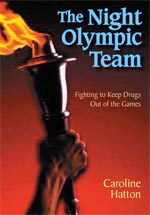
So I did! I wrote an article, “The Night Olympic Team.” Cricket magazine published it first, then The School Magazine in Australia and YES Mag, the Canadian science magazine for young readers.

To grow the article into a book, I interviewed the key players. I wrote about their childhoods, career paths, and role in the Olympic story. I inserted each player’s details after the first time he or she appeared in the book manuscript. This took me a year and a half.

And just as I was finally getting this longer version done, a doubt surfaced in my mind. This doubt turned out to be a good question.

Which would be better? A longer book including key players’ profiles or a shorter book without them?

This was the most important decision I faced while writing the book.

The longer book would let readers dig deeper. The shorter book would be quicker and easier to read. My writing buddies, as well as famous author Caroline Arnold all agreed that a shorter book would appeal to more readers.

I decided to shorten the book. I couldn’t simply go back to the article version, which filled only five magazine pages. A book needed some details about the key players’ roles and background. After spending a year and a half writing the long version, it took me only two weeks to shorten it.

How exactly did I do it? I spread the pages on the floor and crossed out the characters’ profiles with a big marker. Then I entered the changes in my Word file and reprinted it. The next day, I read what I got. It felt like reading the bare bones of the story, like sitting down for a meal but being served only the bones of a fish. I had cut way too much. What to do? Add bits and pieces back in one by one, or start over?

I started all over. This time I cut more gingerly, down to half of the original length. Then I split the story into nine chapters.

Next came the most fun part: writing the transitions between chapters! Each chapter ends at a place that leaves readers wanting to know what happens next. Each chapter then has a fact box packed with extra info. I needed to make sure that when readers turned the page and began to read the next chapter, they would know where they were in the story. Writers must figuratively take readers by the hand and never let go, so they don’t get lost. The first sentence of chapters 2 to 9 takes care of that. Those sentences were the last thing I wrote. Perhaps it was the most fun because it was quick and easy. Perhaps it was because the book was finally done, done, done!

And that’s the version that was published with minor changes.


This post is adapted from part of an interview of mine by Beckie Weinheimer, author of the novel, Converting Kate.

Caroline Hatton and Beckie Weinheimer

LINKS

• Book writers often cut big chunks out of manuscripts to shape their books. Those parts can become short stories or articles in magazines, chapters in new books, or blog posts. Three profiles that I cut from The Night Olympic Team are posted at this blog, to show glimpses of the childhoods and career paths of key players in the book: click here, here or here to read them.

• For a “glimpse” at how my editor and I came up with the book subtitle, "Fighting to Keep Drugs Out of the Games," click here.

• For a ton of links about science writing, scroll down to LINKS AND MORE after you click here.

December 17, 2010

Follow a science writer and editor crafting a book subtitle – a STEM career glimpse

by me, your blogger, Caroline Hatton
.
.
If you love words and science, you can live happily ever after as a science writer.
.
Science can transport me into whole new worlds. So can reading. But when I write, I have the power to take readers into another world.
.

Capturing science book ideas
.
Most science writers are scientists who love writing (like me) or writers who love science.
.
Science writers must be capable of learning about at least one area of science, and they must write well enough to make it clear and infect readers with passion.
.
I have two science degrees: a pharmacist degree and a Ph.D. (Doctor of Philosophy, a doctoral degree) in Chemistry. As a scientist, I help test athletes for performance-enhancing drugs that are prohibited in sports because using them is cheating, it can be dangerous to health, and it's contrary to the spirit of sport.
.
While working at the 2002 Winter Olympics in Salt Lake City, I was on the team of scientists that caught three athletes on a prohibited drug. They had won a total of eight medals. We scientists helped officials and lawyers determine that the right thing was for the athletes to return all their medals, so they could be awarded to the rightful winners.
.
I'll never forget the night, the instant when the thought flashed through my mind, "Some day, I will write this story for children."
.
So I did!
.
My article, "The Night Olympic Team," got published in Cricket in the United States, then in The School Magazine in Australia and YES Mag, a children's science magazine in Canada (under the title, "Finding Gold for Canada").
.
I spent two years growing the article into a book. When I submitted my book manuscript to editors, the title was The Night Olympic Team and the subtitle was Inside a Drug Scandal.
.
For nonfiction books, I like when the title is intriguing and the subtitle crystal clear. That way, the title grabs me and makes me itch with curiosity. But the subtitle had better tell me exactly what the book is about.
.
The Night Olympic Team is a title that I had tried to use since the Fall of 2000. My longtime boss, beloved friend and a pioneer of drug testing in sports, Dr. Don Catlin at the UCLA Olympic Lab where I worked, had just come home from the Summer Olympics in Sydney. He had been asked to write a report for a campus newspaper, UCLA Today.
.
As his ghost writer, I often created drafts for him--internal university memos, manuscripts for scientists, lawyers or lay readers, international correspondence, and proposed protocols and policies for drug testing in sports. My words jumpstarted his thinking. Can you imagine how much more you could get done if someone drafted your homework for you?
.
Sometimes Don Catlin signed the letters I printed for him. Other times he threw out all my words and ideas, and wrote his own piece. Between these extremes, we spent many hours and days of our lives revising, debating, bickering, arguing, or avoiding one another, all for the sake of helping one another and fighting for The Cause--against drugs in sports--to protect the athletes' freedom to compete without taking drugs.
.
For UCLA Today, the report I drafted for Don in 2000 began like this:
.
The night Olympic team
.
The [N]th Olympic Summer Games are over down under. Beneath the exuberance, fanfare and cheer there were discordant notes every time athletes got caught with performance-enhancing drugs in their urine--but we heard so much about positive tests only because the multinational Olympic team at the Sydney laboratory did such a good job finding drugs. The scientists deserve medals, yet the only gold they got came in specimen bottles in the middle of the night.
.
When Don read that last sentence, he humphed, "Gross. No one's going to print anything like it." Although he never submitted my draft for publication, eight years later (in 2008), my book was published with something very much like it on the first page. :-)
.
As for the subtitle, Inside a Drug Scandal, one Friday afternoon in 2007, three months before my book manuscript was to be declared final and sent to the printer, my editor extraordinaire (that's a French word that means that he's a star), Andy Boyles at Boyds Mills Press, e-mailed me about it.
.
His concern was the suggestion that the book might be about "the *latest* drug scandal, whatever that might be years down the road." Prospective buyers night think, "Oh, I just read about that in the Times. No need to buy this book."
.
Andy wanted the subtitle to indicate that the book is not only about one scandal, but also about the general effort to quash the use of drugs in sports. He had spent time trying to come up with ideas and shared a long list of possibilities, including:
.
THE NIGHT OLYMPIC TEAM
.
The lab that fights drugs in sports
.
Keeping drugs out of the Games
.
Fighting drugs in sports
.
.
The following Monday afternoon, I replied by e-mail:
.
How about
.
THE NIGHT OLYMPIC TEAM
.
fighting to free sports from drugs
.
or
.
the untold story of a drug scandal
.
.
Andy sent three new ideas, one of which, "Fighting for Drug-Free Games," he acknowledged to be a bit of a tongue-twister. His e-mail ended with "???"
.
To avoid missing any possibility, I wrote keywords on paper slips and shuffled them, reading the permutations aloud until I got this:
.
.
Then I went to peck on my keyboard:
.
THE NIGHT OLYMPIC TEAM
.
Fighting to Keep Drugs Out of the Games
.
?
.
I liked the ring of it all. It rolled off my tongue easily with no risk of tripping and with a nice, strong beat.
.
I clicked "Send."
.
The phone rang. It was Andy. He wanted to make sure I could live with it.
.
Yes!
.
My book had a title and a subtitle. It was becoming real.
.
This was a milestone in the life of my book, itself a milestone in my life. And it was only the eight-word subtitle of a 6,000-word book! The rest... is another story.
.
.
ABOUT ME, CAROLINE HATTON
.
When I'm not working, I love to make miniatures, quilt, hike, backpack, ride horses, or cross-country ski.
.

.
LINKS AND MORE

* Follow a science writer...

...shaping a book.

...using a motivation trick (telling a friend).

...using a motivation trick (keeping a Hope Journal).

...using a motivation trick (finishing projects before starting new ones)

* Read a paragraph-long description of science writing careers at the Sloan Career Cornerstone Center.

* For an overview, read "Science Careers: Science Writer" at ScienceBuddies.org.
.
* For another overview, read "A Guide to Careers in Science Writing" by the Council for the Advancement of Science Writing.
.
* For a brief overview and paragraph-long profiles of the contributors to the Computing Life website, read "Writing Life" by Emily Carson.
.
* For a thrill, read an article and brief summaries about the winners of the science journalism awards of the American Association for the Advancement of Science.
.
* Read fascinating notes about how award-winning author Caroline Arnold got ideas for her books, such as Global Warming and the Dinosaurs, and about her experiences researching and writing them. She is the author of 150 children's books inspired by her love of nature and by her travels. Many of her books have received awards as science books.
.
* Find out how author Sneed B. Collard III researches some of his science books for older younsters.
.
* Read about how I do research for science writing, in this interview of mine by another author, Vicki Leon:
.
- part 1 about interviewing experts... with more or less success!
.
- part 2 about fact-checking
.
- part 3 about weaving together the scientist's adventures in life and the science
.
* Read a terrific interview of astronomer, teacher, and science writer Alan Hirshfeld (part 1 and part 2) by Vicki Leon.
.
* Get some tips for adult, professional beginners.
.
* For clear, strong advice to help you become a better science writer, read Chapter 15, "Science and Technology," in the book by William Zinsser, On Writing Well - The Classic Guide to Writing Nonfiction. It's one of my favorite chapters in one of my favorite books about writing.
* Read about a job broader than just writing, in the article "Science Communication as a Press Officer" by Christine Pulliam, who has a Master's degree in astronomy.

* For an overview of a related career, Technical Writer, read the ScienceBuddies.org page.
.
Updated March 29, 2012.