Showing posts with label PUZZLE. Show all posts
February 8, 2012
Factory balls - test of problem-solving skills
Goal: paint a ball to make it look like the one on the box.
How: drag a ball and drop it on the tools, in logical order.
Click here and have fun!
October 17, 2011
Animal rescue - tests of problem-solving skills
Each activity at the link below has its own mini-rules, within which you can solve the problem.
GOAL: help the rabbit reach the treat he wants.
HOW: explore each picture--point, click, drag, drop--to discover what is or is not possible, then figure out a logical way to reach your goal.
Click here and have fun!
July 12, 2011
Follow an analytical chemist who protects horses – a STEM career glimpse and puzzle
Horses thunder past, stretch across the finish line. The fastest one wins by a nose. Victory brings fame and fortune to the owner.
And this victory is the end result of generations of expert horsemen and horsewomen breeding generations of extraordinary horses, and of the horse’s years of hard work with fine trainers, so that the best may win on race day. At least that’s the way it should be.
Unfortunately, money is at stake, so that some people cheat to help a horse they own, or train, win races. One kind of cheating is doping by giving drugs to horses to make them run faster.
Some people give shots of blood booster drugs to horses. More red blood cells carry more oxygen to all tissues in the horse’s body, including muscles. Instead of getting tired in the last stretch, the horse can keep going full tilt. But this is cheating, therefore it is is prohibited.
How can one catch cheaters? By testing the horse for prohibited drugs: blood and urine samples are collected after races.
Lab scientists test the samples for prohibited drugs. If the scientists find one, the people responsible for that horse have broken the rules and must be punished.
But what happens when a new drug becomes available? For example, by 2008, a new and improved blood booster medicine, CERA, had become available. CERA was invented to treat humans who have serious medical problems, not to help healthy athletes or horses cheat!
Researchers in Europe invented a test to look for CERA in athletes’ samples. Sadly, they found CERA in athletes' samples, including from 2008 Tour de France and Beijing Olympics cyclists.
Fortunately for horses everywhere, Dr. Yan Chang was already working hard to fine tune a test to find CERA in horses’ samples. If there is a test, cheaters might get caught, so they will think twice before giving a horse a shot, and hopefully they will forget it.
Dr. Yan Chang
She spends three days just preparing the samples. She treats them in a special way that cuts the CERA molecules, if they’re there, into pieces. One of those pieces, “T6,” can only come from CERA, nothing else. So finding T6 proves that CERA was there. To see whether T6 was there, Yan analyzes her samples by chromatography and mass spectrometry.
Yan uses chromatography and mass spectrometry
to test horse samples for a prohibited drug
Chromatography separates the ingredients of a mixture. The mixture goes into the machine, and the ingredients come out one by one at the other end. In the example below, chromatography has separated the two ingredients in a mixture:
Yan uses chromatography to separate T6 from all the other things in the horse’s blood. Then she uses mass spectrometry to identify T6.
For an explanation of how chromatography and mass spectrometry help identify chemicals, watch my TV science lesson (part 1 – from 3:30 minutes to the end at 10 minutes) by clicking here.
How exactly does Yan read what she gets from a test—the data?
Yan reads data
First of all, she always compares the unknown sample to known samples (controls): one control known to be negative (-) (because it’s blood from a research horse who was never given CERA) and one control known to be positive (+) (because Yan herself sprinkled CERA into horse blood in a test tube).
(In my TV science lesson, I omitted the negative control for the sake of simplification, to make room for other details.)
Yan’s data look like this:
- In the picture below, for the positive control (+), Yan knows that T6 is present, and sure enough, there are two peaks. The two peaks line up on the same vertical. The top peak is bigger than the bottom peak. The top peak is three times bigger than the bottom peak. That’s what the data look like when T6 is present.
- In the next picture, for the negative control (-), Yan knows that T6 is absent, and sure enough, there is no peak.
- Yan now looks at the unknown data (?) in the picture below, and asks three questions.
- Question 1: are there peaks?
- If not, the sample is negative
- If yes, Yan goes on.
- Question 2: are the top and bottom peaks lined up with each other on the same vertical as the positive control?
- If not, the sample is negative
- If yes, Yan goes on.
- Question 3: is the top peak three times bigger than the bottom peak, like for the positive control?
- If not, the sample is negative
- If yes, the sample is positive for T6.
That’s the big idea, although it was simplified to avoid giving you a headache.
Now it’s your turn to be a horse-race detective. Ask Questions 1, 2, and 3 about samples A-I below. Decide which horse was doped with CERA.
A: Attahorse
B: Beeg
C: Catch Me Tomorrow
D: Desert Wind
E: Egg Beater
F: Flies Like An Arrow
G: Girl Power
H: His Goofiness
I: Itching To Run
Click here for the answers.
Yan and her teammates published the test recipe in a science journal so other lab scientists can do it too. This protects race horses from being doped with CERA.
A NOTE ABOUT MATCHING PICTURES
If you take pictures of your cat, ten in a row, you don’t expect all of them to be identical. Yet anyone can tell that it’s the same cat—there’s a match! Scientists look at data the same way: to identify a drug, the unknown and the positive control don’t have to be identical, but they have to match well enough.
ABOUT YAN CHANG
• Yan has earned a Bachelor of Science (B.S.) degree in Chemistry from Shanxi University (Taiyuan, People's Republic of China or PRC) and a doctoral degree (Ph.D.) from the Chinese Academy of Medical Sciences (Beijing, PRC).
• She now lives in California.
• When she's not working, she loves to spend time with her young daughter playing puzzles and reading. She also loves to cook.
LINKS & MORE
• The reference for Yan’s publication in a science journal is
Y. Chang, G. M. Maylin, G. Matsumoto, S. M. Neades and D. H. Catlin. Screen and confirmation of PEG-epoetin β in equine plasma, Drug Testing and Analysis, 2011, 3:68–73.
Disclaimer: the substance of this publication was greatly simplified in order to adapt it for the above blog post.
• Go behind the scenes at a British race track. See how an official collects a sample from a horse, in the video at this web page.
• For an overview of chemistry careers, click on “Podcast" at the Sloan Career Cornerstone Center. It’s an introduction to the required schooling, a day-in-the-life of a chemist, jobs, and more.
• Read a paragraph-long description of analytical chemistry
• Read a paragraph-long description of forensic chemistry (analyzing evidence of a crime), or a two-page-long description of forensic chemistry
• Read an overview of Forensic Science Technician careers at ScienceBuddies.org.
• This info-packed web page by the American Chemical Society contains descriptions of eight different analytical chemists’ jobs, in the following specialties:
- Forensic Pharmaceutical Analysis
- Product Marketing
- Entrepreneur: Analytical Chemistry
- Entrepreneur: Analytical Chemistry Systems Integration
- Bioanalytical-Related Chemistry
- Environmental Analysis
- Chemometrics/Fish Products and Food Quality
Updated January 31, 2012
LINKS & MORE
• The reference for Yan’s publication in a science journal is
Y. Chang, G. M. Maylin, G. Matsumoto, S. M. Neades and D. H. Catlin. Screen and confirmation of PEG-epoetin β in equine plasma, Drug Testing and Analysis, 2011, 3:68–73.
Disclaimer: the substance of this publication was greatly simplified in order to adapt it for the above blog post.
• Go behind the scenes at a British race track. See how an official collects a sample from a horse, in the video at this web page.
• For an overview of chemistry careers, click on “Podcast" at the Sloan Career Cornerstone Center. It’s an introduction to the required schooling, a day-in-the-life of a chemist, jobs, and more.
• Read a paragraph-long description of analytical chemistry
• Read a paragraph-long description of forensic chemistry (analyzing evidence of a crime), or a two-page-long description of forensic chemistry
• Read an overview of Forensic Science Technician careers at ScienceBuddies.org.
• This info-packed web page by the American Chemical Society contains descriptions of eight different analytical chemists’ jobs, in the following specialties:
- Forensic Pharmaceutical Analysis
- Product Marketing
- Entrepreneur: Analytical Chemistry
- Entrepreneur: Analytical Chemistry Systems Integration
- Bioanalytical-Related Chemistry
- Environmental Analysis
- Chemometrics/Fish Products and Food Quality
Updated January 31, 2012
Labels:
Analytical chemist,
BOOST-STEM,
chemist,
Chinese,
girls,
GLIMPSE,
high school,
middle school,
PUZZLE,
science,
STEM,
Yan Chang
April 8, 2011
Follow a computer graphic artist illuminating the movie “WALL•E” – a STEM career glimpse and puzzle
Have you seen "Brave," "Up," or "WALL•E"?
Think about your favorite one. Were you swept away?
Artists hand-sketch a comic-book version--the "storyboards." Actors record the characters' voices, reading scripts and improvising. The editorial team puts together storyboards and voices to create a draft--the reels of the film's sequences. .
Think about your favorite one. Were you swept away?
You probably didn't stop to think of this while enjoying the movie, but it was created from scratch, image after countless image, frame by frame, by artists using complex computer programs.
And those programs are used and developed by people like Danielle Feinberg, a Director of Photography for Lighting at Pixar. When asked what she loves best, computers or art, her answer is, "programming computers to create awesome art work!" Danielle is one of several hundred team members who bring these movies to a theater near you.

And those programs are used and developed by people like Danielle Feinberg, a Director of Photography for Lighting at Pixar. When asked what she loves best, computers or art, her answer is, "programming computers to create awesome art work!" Danielle is one of several hundred team members who bring these movies to a theater near you.

Danielle Feinberg
To make a computer animated (or "digitally animated") movie, creators first dream up the story and "pitch it"--they talk big shots into seeing the possibilities. Next, they put it in writing in a short "story treatment."
Artists hand-sketch a comic-book version--the "storyboards." Actors record the characters' voices, reading scripts and improvising. The editorial team puts together storyboards and voices to create a draft--the reels of the film's sequences. .
The art department creates, with pencils, paintbrushes, paper and also computers, art work to describe the look and feel of the characters and their world. Soon everyone uses computer software to do each step. .
Model builders build the characters, sets and props in the computer as 3D (3-dimensional) objects, plotting points using the X, Y and Z axes. Modelers and articulators add controls that act like hinges so they can move parts like elbows or doors. .
The layout crew places the characters and camera in the world, and designs each camera move (or "shot"). Like puppeteers, animators create movements and facial expressions. They let the computer do the "in-betweening," filling in the movement between frames. .
Clap! Bang! Boom! From the beginning to the end of the whole process, the editorial team rearranges the shots, and adds music and sound effects to create the ever-evolving, current version of the movie. .
Shaders added to all the objects describe color, texture and how the material interacts with light (reflective, translucent, dull, etc.). Visual Special Effects artists use all kinds of physics to create fire, explosions, mist and more. The lighting team adds virtual lights and reflections that support the mood and story, and reveal the emotions in each scene. .
Finally, the rendering team sends the files that contain all of this information off to a giant "farm" of computers, where millions of calculations are done to create each pixel on every frame of the final movie. .
Imagine stopping the movie on one image or frame. As Danielle explains, a computer image is made up of over 1.5 million pixels. Think of one pixel on WALL•E's face. It's yellow because that's WALL•E's color. But if the sun is shining from the right and it's late in the day and a reflection is hitting him right at that pixel while the wind is blowing dust around, all these factors are going to affect the exact shade of yellow of that pixel, including in relationship to other pixels around it. The computer must do billions of calculations to take into account all those subtle effects--pixel by pixel, frame by frame, 24 frames per seconds, some 90 minutes per film. .
And the computer software is used, cajoled, finessed, and sometimes even "tricked" by Danielle and her team to create these images that make up a film. .
How exactly does Danielle do it? From one of the three computers at her desk, Danielle picks a shot or series of shots (a "sequence") to work on. She retrieves from the Pixar network all the information ("data") created by everyone else so far, about sets, characters, camera, animation and materials. She looks at the image ("direction") from the art department that shows the time of day, weather or mood of the lighting. Then she adds lights into the 3D world inside the computer, using 30 or 40 controls over each light (the sun, a lamp, reflections...) to build up the image to look like the art reference.
Each morning, Danielle reviews the results of her work by watching the overnight "renders"--a single frame takes hours of computer calculations to render, anywhere from a couple of hours to 90 hours or more in extreme cases. She adjusts the lighting to get closer and closer to the desired look, and fixes the myriad of technical issues that can crop up in the complex software. This takes a week to a month or more depending on how big a chunk of movie she's working on. Danielle and the lighting artists each sit down with the director (who is responsible for the creative content) to show him or her their work, hoping for a "Final!" from the director, meaning that their work on that shot is done and ready to go into the movie.
PUZZLE: Can you spot WALL•E in the frame below, shown before lighting?
She also works with her team to come up with new ways to create what each film needs, such as how to make the world look like it's underwater for "Finding Nemo" or how to create a messy, polluted, dusty world in "WALL•E." Using physics, geometry, a lot of math, and computer programming skills, Danielle and the other animation scientists add to the software for each movie. They make each new world or character possible.
And so from one Pixar team to the next, step by painstaking, exhilarating step, vibrant characters and exotic worlds burst alive.
And so from one Pixar team to the next, step by painstaking, exhilarating step, vibrant characters and exotic worlds burst alive.Finally, photoscientists record the movie in a form that can be played in the theater, as well as on televisions, computers, and mobile screens.
Then, images brimming with light tell you a story, make you gasp, laugh, or blink away tears. And now you know how, with math and science and a lot of heart, Danielle makes it happen, lighting the way on screen and in real life.
ABOUT DANIELLE FEINBERG
Director of Photography - Lighting
Pixar Animation Studios
* Danielle began her career at Pixar Animation Studios in February 1997 as a Render Technical Director (also called a "Render Wrangler") on the feature film "A Bug's Life." She quickly discovered her love for lighting and went on to light many of Pixar's feature films including "Toy Story 2," "Monsters, Inc.," and the Academy Award(R)-winning "Finding Nemo," "The Incredibles" and "Ratatouille." Danielle worked as the Director of Photography for Lighting on another Oscar(R)-winning feature, "WALL•E," and is now working on the look for her next project, Disney•Pixar's 2012 summer release, "Brave."
* Danielle's love of combining computers and art began when she was eight years old, and first programmed a logo turtle to create images. This eventually led her to a Bachelor of Arts in Computer Science from Harvard University. Now, in addition to her Pixar work, she works with teenage girls, encouraging them to pursue math and science by demonstrating to them the same beautiful simplicity she found with the programmed art of the Logo turtle. .
inspires girls to follow their dreams at a Tech Trek science camp.
* When Danielle is not working, she loves to travel, shoot photographs, and play sports like flag football.
LINKS AND MORE
* See Danielle when she was in elementary school.
* Watch Danielle talk about the making of "WALL•E" on the DVD Bonus Features (Disc 2, Behind the Scenes, "The Imperfect Lens").
* Another interesting "WALL•E" DVD bonus feature is "Life of a Shot."
* Take a video tour of Pixar, complete with a giant poofy armchair and play areas.
* See profiles, art work, and interviews of artists such as animators, a director of photography, and a sculptor who work at Pixar.
* See the different looks created by software for... trash in "WALL•E."
* Visit Tribeca Flashpoint Academy, a Digital Media Arts College in Chicago. It offers two-year college degrees to train arts or entertainment professionals to work on computer-based specialties such as games, recording, or animation. Tribeca Flashpoint also offers an abbreviated, Digital Bootcamp program for high school students grades 10 through 12. Students experience a taste of Tribeca Flashpoint's program and complete one portfolio piece.
* Create your own animated film. The New York Film Academy Summer Film and Acting Camps for teens and tweens include 3D Computer Animation Camps in New York City and at Harvard University. Students with little or no experience learn how to build objects and creatures, animate them, and add color, light, and sound, to create their own short film!
* For creative kids who love computers: look at the Digital Media Academy teen summer camps. The filmmaking camp helps you start your career in the movie business by learning scriptwriting, storyboarding, editing, visual effects, and more.
* iD Tech Camps include 3D Computer Animation summer camps, where you can create your own characters and bring them to life, then take home a portfolio and a trial version of the software.
Updated on July 13, 2012
* Create your own animated film. The New York Film Academy Summer Film and Acting Camps for teens and tweens include 3D Computer Animation Camps in New York City and at Harvard University. Students with little or no experience learn how to build objects and creatures, animate them, and add color, light, and sound, to create their own short film!
* For creative kids who love computers: look at the Digital Media Academy teen summer camps. The filmmaking camp helps you start your career in the movie business by learning scriptwriting, storyboarding, editing, visual effects, and more.
* iD Tech Camps include 3D Computer Animation summer camps, where you can create your own characters and bring them to life, then take home a portfolio and a trial version of the software.
Updated on July 13, 2012
February 14, 2011
Guess who this girl grew up to be in my book, The Night Olympic Team
Readers of my science book, The Night Olympic Team, ask me for glimpses of the childhood and career path of key players in the book. Here's another one. .

Doesn't she look like she was born to play? .
Her science career started with a bang! At age twelve, she and a friend combined all of the glassware and products from their two chemistry sets, then heated the flasks to make something happen. Multicolor products started racing around. Bubbles overflowed. Then... BOOM! It splattered stinky brown ooze everywhere. Both girls let out a gasp and a giggle. There were no casualties, except for the kitchen, which had to be repainted. The girls got in big trouble for their recklessness. They could have been injured or even killed. .
As a kid growing up in France, she loved to read about biology to learn how living things work. She went to medical school to learn how the numan body can get out of whack and get sick, and how to fix it. skip line . .
She signed up to do a research project. She was scared, because everything was new to her, but she did O.K. and she liked working in a lab. By the time she became a doctor, she had published her first scientific article in an international journal. skip line. .
She never became the kind of doctor who sees patients. Instead, she did research. Her task was always to make a lab test work. But in truth, "All the science work I've ever done was to satisfy my hunger for play," she says. "I love to play computer sleuthing games, to figure out whodunit in crime novels, and recently I developed a passion for genealogy [that's family tree science], which is detective work into the past." . .
WHO IS SHE? . .
* Caroline Hatton (that's me, your blogger), scientist (I help test athletes for prohibited performance-enhancing drugs) and author of The Night Olympic Team? . .
* Francoise Lasne [pronounced fran-swahz lahn], scientist, who perfected a test to find prohibited drugs in athletes' samples? . .
IF YOU GUESSED FRANCOISE LASNE, YOU WERE RIGHT! . .
She's a scientist who catches sports cheaaters nd defends honest athletes who compete drug-free. Read about her work in the book, The Night Olympic Team. She is the current Director of the French national anti-doping laboratory (AFLD Departement des analyses). .
.
Doesn't she look like she was born to play? .
Her science career started with a bang! At age twelve, she and a friend combined all of the glassware and products from their two chemistry sets, then heated the flasks to make something happen. Multicolor products started racing around. Bubbles overflowed. Then... BOOM! It splattered stinky brown ooze everywhere. Both girls let out a gasp and a giggle. There were no casualties, except for the kitchen, which had to be repainted. The girls got in big trouble for their recklessness. They could have been injured or even killed. .
As a kid growing up in France, she loved to read about biology to learn how living things work. She went to medical school to learn how the numan body can get out of whack and get sick, and how to fix it. skip line . .
She signed up to do a research project. She was scared, because everything was new to her, but she did O.K. and she liked working in a lab. By the time she became a doctor, she had published her first scientific article in an international journal. skip line. .
She never became the kind of doctor who sees patients. Instead, she did research. Her task was always to make a lab test work. But in truth, "All the science work I've ever done was to satisfy my hunger for play," she says. "I love to play computer sleuthing games, to figure out whodunit in crime novels, and recently I developed a passion for genealogy [that's family tree science], which is detective work into the past." . .
WHO IS SHE? . . * Caroline Hatton (that's me, your blogger), scientist (I help test athletes for prohibited performance-enhancing drugs) and author of The Night Olympic Team? . .
* Francoise Lasne [pronounced fran-swahz lahn], scientist, who perfected a test to find prohibited drugs in athletes' samples? . .
IF YOU GUESSED FRANCOISE LASNE, YOU WERE RIGHT! . .
She's a scientist who catches sports cheaaters nd defends honest athletes who compete drug-free. Read about her work in the book, The Night Olympic Team. She is the current Director of the French national anti-doping laboratory (AFLD Departement des analyses). ..
February 7, 2011
It's a bird! It's a cat! Test your visual skills
This National Geographic interactive puzzle times how long it takes you to arrange shapes (such as triangles and squares) to cover a picture (such as a cat design).
Labels:
high school,
middle school,
PUZZLE,
STEM,
test of observation skills
January 31, 2011
Guess who this kid grew up to be in my book, The Night Olympic Team
Readers of my science book, The Night Olympic Team, ask me for glimpses of the childhood of key players in the book. Here's another one.
.
He grew up in the jungle, deep in the wilds of West Africa, running free with his playmates. Where he lived, way out in Liberia and far from any city, there weren't any schools.
.
.
"My mother taught me to read and write, that was it," he recalls. I always liked reading. I read whatever was available, from books to Reader's Digest, anything that came by."
.
As the son of missionaries from Sweden who built leper colonies, Swedish was his first language. He also spoke the local, African dialects with his friends, and picked up pidgin English--a regional jargon.
.
Where he grew up there was no television, no radio, no newspapers. Only books. He found out about ongoing world events by reading about them in Reader's Digest two years later.
.
Except for his parents, people around him looked nothing like him. They were black. "Most people around me, very nice people, whom I liked very much, were illiterate rice farmers." Considering that he's become a big shot on the international scene in his profession, he muses, "I had to have an idea at some point that perhaps I would go to school."
.
He did eventually go to school, but not until age thirteen! His parents sent him to America where he went to high school in Monrovia, a suburb near Los Angeles.
.
Was it hard to go to school and speak English? "I don't remember that it was," he says. "I think I probably talked a bit funny to the other kids. But people were very nice and very welcoming."
.
After high school, he went to college at Harvard, then to Yale to study what he does now. He had settled in Paris, France, to practice his profession, when he became involved in The Night Olympic Team story.
.
WHICH ONE OF THE KEY PLAYERS IN THE NIGHT OLYMPIC TEAM IS HE?
.
In order of appearance:
.
Jeff Gorzek, scientist, who tests athletes' samples for prohibited drugs?
.
Don Catlin, scientist and lab director, whose team found a prohibited drug in athletes' samples? The drug was a blood-booster medicine invented to treat medical patients, not to help healthy athletes cheat by boosting their endurance!
.
Steve Elliott, scientist, who invented the medicine?
.
Jacques Rogge, President of the International Olympic Committee?
.
Jan Paulsson, lawyer?
.
Zac Douglas, lawyer?
.
IF YOU GUESSED JAN PAULSSON, YOU WERE RIGHT!
.
As a lawyer, Jan works on cases based on science, so he needs a pretty deep understanding of the science. It is not rare for people to have noth science and law degrees.
.
Jan says that going to law school leads to lots of choices of things to work on. Examples include sports, medicine, the environment, and specialties without science.
.
He adds, "People who are good lawyers have it in their genes." He claims that you can observe children and predict which ones could become good lawyers. "They argue about things. They'll say, 'Oh yes, I know you told me not to eat all the cookies, but that was on a Tuesday and today's Wednesday and I didn't realize that it was every day.' You find children who naturally see the world that way." Was Jan like that as a kid? Absolutely!
.
He grew up in the jungle, deep in the wilds of West Africa, running free with his playmates. Where he lived, way out in Liberia and far from any city, there weren't any schools.
.
."My mother taught me to read and write, that was it," he recalls. I always liked reading. I read whatever was available, from books to Reader's Digest, anything that came by."
.
As the son of missionaries from Sweden who built leper colonies, Swedish was his first language. He also spoke the local, African dialects with his friends, and picked up pidgin English--a regional jargon.
.
Where he grew up there was no television, no radio, no newspapers. Only books. He found out about ongoing world events by reading about them in Reader's Digest two years later.
.
Except for his parents, people around him looked nothing like him. They were black. "Most people around me, very nice people, whom I liked very much, were illiterate rice farmers." Considering that he's become a big shot on the international scene in his profession, he muses, "I had to have an idea at some point that perhaps I would go to school."
.
He did eventually go to school, but not until age thirteen! His parents sent him to America where he went to high school in Monrovia, a suburb near Los Angeles.
.
Was it hard to go to school and speak English? "I don't remember that it was," he says. "I think I probably talked a bit funny to the other kids. But people were very nice and very welcoming."
.
After high school, he went to college at Harvard, then to Yale to study what he does now. He had settled in Paris, France, to practice his profession, when he became involved in The Night Olympic Team story.
.
WHICH ONE OF THE KEY PLAYERS IN THE NIGHT OLYMPIC TEAM IS HE?
.
In order of appearance:
.
Jeff Gorzek, scientist, who tests athletes' samples for prohibited drugs?
.
Don Catlin, scientist and lab director, whose team found a prohibited drug in athletes' samples? The drug was a blood-booster medicine invented to treat medical patients, not to help healthy athletes cheat by boosting their endurance!
.
Steve Elliott, scientist, who invented the medicine?
.
Jacques Rogge, President of the International Olympic Committee?
.
Jan Paulsson, lawyer?
.
Zac Douglas, lawyer?
.
IF YOU GUESSED JAN PAULSSON, YOU WERE RIGHT!
.
As a lawyer, Jan works on cases based on science, so he needs a pretty deep understanding of the science. It is not rare for people to have noth science and law degrees.
.
Jan says that going to law school leads to lots of choices of things to work on. Examples include sports, medicine, the environment, and specialties without science.
.
He adds, "People who are good lawyers have it in their genes." He claims that you can observe children and predict which ones could become good lawyers. "They argue about things. They'll say, 'Oh yes, I know you told me not to eat all the cookies, but that was on a Tuesday and today's Wednesday and I didn't realize that it was every day.' You find children who naturally see the world that way." Was Jan like that as a kid? Absolutely!
January 20, 2011
Fun in black and white - test of observation skills
What do you see (or what do you think you see) after clicking here?
Labels:
high school,
middle school,
PUZZLE,
science,
STEM,
test of observation skills
January 12, 2011
Guess who this kid grew up to be in my book, The Night Olympic Team
Readers of my science book, The Night Olympic Team, ask me for glimpses of the childhood and career path of the key players in the book. Here's one.
.
They could not keep him from tinkering forever. When he was in third grade, he walked past their hobby shop on the way to school. What he wanted was not model airplanes, but the vials lined up on a shelf, full of colorful stuff: salts, minerals, chemicals. He knew they would make for great experiment. He asked the shop people "how to make something cool happen--catch on fire, maybe blow up?" But instead of helping him, they refused to sell vials to him. Imagine that!
.
.
Despite this setback, he grew up to be a scientist who would use recombinant DNA technology (a way to cut and paste DNA) to invent a supermedicine. While in college at the University of California at Irvine, he fell in love with DNA. He thought, "Cool! That's what I want to do. Work on that."
.
.
By trailblazing where nature had no plans to go, he made something cool happen for millions of patients.
.
WHICH ONE OF THE KEY PLAYERS IN THE NIGHT OLYMPIC TEAM IS HE?
.
In order of appearance:
.
Jeff Gorzek, scientist, who tests athletes' samples for prohibited drugs?
.
Don Catlin, scientist and lab director, whose team found a prohibited drug in athletes' samples? The drug was a blood-booster medicine invented to treat medical patients, not to help healthy athletes cheat by boosting their endurance!
.
Steve Elliott, scientist, who invented the medicine?
.
Jacques Rogge, President of the International Olympic Committee?
.
Jan Paulsson, lawyer?
.
Zac Douglas, lawyer?
.
IF YOU GUESSED STEVE ELLIOTT, YOU WERE RIGHT!
.
Steve is a Scientific Director at Amgen, a therapeutics company in Thousand Oaks, California. He worked on EPO, the body's natural blood-boosting hormone. He led the team that invented NESP (also called Aranesp or darbepoetin alfa), a longer-lasting version of EPO. He plays a key role in The Night Olympic Team.
.
MORE ABOUT STEVE
.
Steve loves to play golf... before going to work.
.
They could not keep him from tinkering forever. When he was in third grade, he walked past their hobby shop on the way to school. What he wanted was not model airplanes, but the vials lined up on a shelf, full of colorful stuff: salts, minerals, chemicals. He knew they would make for great experiment. He asked the shop people "how to make something cool happen--catch on fire, maybe blow up?" But instead of helping him, they refused to sell vials to him. Imagine that!
.
.Despite this setback, he grew up to be a scientist who would use recombinant DNA technology (a way to cut and paste DNA) to invent a supermedicine. While in college at the University of California at Irvine, he fell in love with DNA. He thought, "Cool! That's what I want to do. Work on that."
.
He started doing research for the professor who had inspired him. He earned a bachelor's degree in biological sciences, then a doctoral degree in molecular biology and biochemistry. For years afterwards, he studied how DNA programs a cell's life and death.
.
.
He went to work for a company which uses biotechnology (one kind of DNA science) to discover medicines to improve people's lives. He started to do research on a protein that's a natural hormone in the body. Soon the company began selling as a medicine an artificial version of the hormone.
.
.
Then there was no need to do research on it any more, right? Wrong! Our mystery man explains why his company continued to study the medicine: "Here we market this wonder drug--we simply must know all about it, understand everything about it."
.
Working on this medicine year after year, he could picture every bit of it in his sleep. Studies showed that the more sugars on the molecule, the better it worked. Logically, our mystery man set out to put as many sugars as he could fit on the molecule, and began creating new versions of the medicine.
.
Some said, "It won't work." Their thinking was that nature had improved this hormone for millenia. Nature had already made the hormone the best it could be. How could humans possibly make it better?
.
Our mystery man said, "How do you know unless you try?"
.
For a kid not allowed to tinker with colored powders, he was having some fun now. He made hundreds of new versions.
.
He worked on the project after hours, on the side, because it was not a "sanctioned" (official) project. His company already made the wonder medicine of all ages. What could top that? Why bother to try? Especially he, who was already a successful scientist by any measure imaginable--working at a world-famous company, published, respected. But he was determined. His enthusiasm got others interested in helping him. They also stayed after hours, testing each new version. Some didn't work, but some worked better, one of them especially.
.
He had succeeded at what some said was impossible. He had created a supermedicine that lasted longer in the body.
.
How had a human mproved upon something that nature had already improved over millenia? Nature refined the hormone to be made whenever the body needs it. The difference with its use as a medicine is that patients get shots. Fewer shots are possible because the benefits last longer--and that makes life easier for the patient. Not bad for a medicine that Steve was not supposed to work on officially.
.
From his lab freezer, he pulls out a white plastic tray packed with vials--his very own grownup collection. "Mutants," he says, his voice resonating with pride. In the palm of one hand, he holds the fruits of years of labor.
.
.By trailblazing where nature had no plans to go, he made something cool happen for millions of patients.
.
WHICH ONE OF THE KEY PLAYERS IN THE NIGHT OLYMPIC TEAM IS HE?
.
In order of appearance:
.
Jeff Gorzek, scientist, who tests athletes' samples for prohibited drugs?
.
Don Catlin, scientist and lab director, whose team found a prohibited drug in athletes' samples? The drug was a blood-booster medicine invented to treat medical patients, not to help healthy athletes cheat by boosting their endurance!
.
Steve Elliott, scientist, who invented the medicine?
.
Jacques Rogge, President of the International Olympic Committee?
.
Jan Paulsson, lawyer?
.
Zac Douglas, lawyer?
.
IF YOU GUESSED STEVE ELLIOTT, YOU WERE RIGHT!
.
Steve is a Scientific Director at Amgen, a therapeutics company in Thousand Oaks, California. He worked on EPO, the body's natural blood-boosting hormone. He led the team that invented NESP (also called Aranesp or darbepoetin alfa), a longer-lasting version of EPO. He plays a key role in The Night Olympic Team.
.
MORE ABOUT STEVE
.
Steve loves to play golf... before going to work.
December 10, 2010
Winter fun – a puzzle
By mid-December, my husband Bill and I plan a cross-country skiing vacation around New Year's Day. We live in California, so we often ski in the Sierra Nevada.
.
Here we are east of Yosemite National Park:
.
.
.
Here we are east of Yosemite National Park:
.
. .
We look for animal tracks such as these:
The wooden stick is one inch long.Can you guess whose tracks they are?
Click here for a clue and for the answer.
November 30, 2010
Holiday fun – a test of observation skills
The day after Thanksgiving, my thoughts turn to an ongoing Christmas project.
*
It all began several years ago, when I saw small Christmas stockings in a store. I liked how they were decorated in detail, but not the color (pale blue) or the price (several dollars each). Besides, most of the time, seeing something I like makes me itch to craft it myself.
*
So I couldn't wait to get home to design and make my own, smaller stockings:
*
*
They are 1-1/4 inch wide. The bright blue and black ones, in my husband's favorite color pair, are for us. The gray and dusty blue ones are for my big brother's family, in colors I've seen them wear.
*
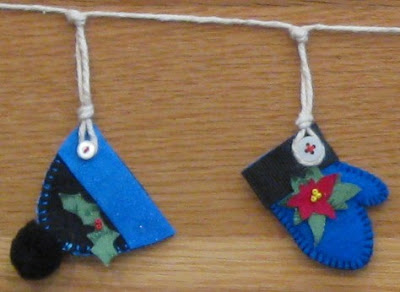
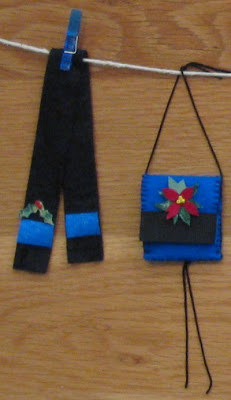
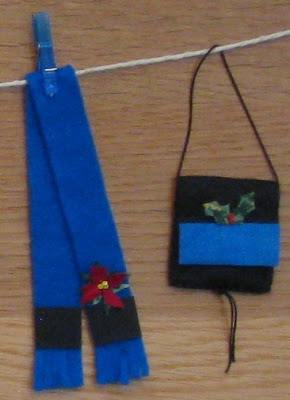
The following year, I made six mittens. The year after that, hats. Then scarves, and now shoulder bags:
*
*
It all began several years ago, when I saw small Christmas stockings in a store. I liked how they were decorated in detail, but not the color (pale blue) or the price (several dollars each). Besides, most of the time, seeing something I like makes me itch to craft it myself.
*
So I couldn't wait to get home to design and make my own, smaller stockings:
*
*They are 1-1/4 inch wide. The bright blue and black ones, in my husband's favorite color pair, are for us. The gray and dusty blue ones are for my big brother's family, in colors I've seen them wear.
*
The following year, I made six mittens. The year after that, hats. Then scarves, and now shoulder bags:
*
Here's the puzzle to test your observations skills: the black and bright blue ornaments follow a pattern, but there are four departures (deviations, details that don't follow the pattern). Can you spot them?
*


** *


Click here for clues and the answer.
November 10, 2010
Be a science detective - test of problem-solving skills #1
Adapted with permission from Professor Daryl Cooper, Department of Mathematics, University of California at Santa Barbara.
.
Picture 12 balls that look identical. One of the balls is either heavier or lighter than the others. If I give you a balance and allow you to make three weighings, how would you go about discovering which ball is the odd one out, and whether it is heavier or lighter than the others?
.

Picture 12 balls that look identical. One of the balls is either heavier or lighter than the others. If I give you a balance and allow you to make three weighings, how would you go about discovering which ball is the odd one out, and whether it is heavier or lighter than the others?
.
Click here for a clue.
.
If you like this puzzle and would like to try more of Daryl's favorites, click here to go to his web page.
Labels:
high school,
middle school,
PUZZLE,
science,
STEM,
test of problem-solving skills
October 17, 2010
Be a science detective - test of observation skills #7 (part 1 of 2)

If you’re afraid of anything in nature, then skip this one—or at least ask someone who’s not afraid of anything natural to check it out and make sure you can enjoy it too.
Ready?
Are you sure?
Here we go.
In July 2010 while hiking in the Mount Baldy area near Los Angeles,

I walked up this slope to go sit in the shade for a snack.
Labels:
high school,
middle school,
PUZZLE,
science,
STEM,
test of observation skills
Subscribe to:
Posts (Atom)